Showing posts with label momless. Show all posts

Wednesday, February 2, 2011

Christopher Cool, Teen Agent #1: X Marks the Spy


Okay, the Christopher Cool, TEEN Agent series is my all time favorite boys series. I cannot tell you how much kitsch-tastic amazingness is contained in each volume. The series was published in 1967-69 by Grosset and Dunlap and written by Jim Lawrence (who wrote the newspaper strip version of James Bond, appropriately enough) under the pen name Jack Lancer. Chris is the son of Dr. Jonathan Cool, "America's foremost brain in high energy physics," who mysteriously disappeared a couple of years ago. Chris goes to the CIA at 17, hoping to get hired and go after his dad. Instead, he gets funneled into the TEEN (Top-secret Educational Espionage Network). Yes, I'm serious. Yes, it's fabulous.


Anyway, two years later, Chris is at Kingston (an Ivy League type college), rooming with his TEEN partner, Geronimo Johnson. Gerry is Apache, which is one of the fifty million languages that Chris speaks fluently. I won't deny that a lot of the Native American humor in this series is kind of cringe-worthy, but most of it's tongue-in-cheek and mocks the other characters, rather than Gerry. Q is their main contact from Control, dresses in a navy blazer and a yachting hat, smokes an unlit pipe, and takes constant swigs from a bottle of milk. Could I make any of this UP? I LOVE IT. The heroine (supporting character) is Spice Carter, a fiery redhead who can hold her own in intelligence and a fight. The villains alternate between the Reds (obvious Cold War influence in the series) and TOAD, which is a network of supervillains aimed on global domination. SQUEE!


In this first title, Chris and Gerry are off to France, in search of a secret weapon Ciel Assassin/Skykill. It's been developed by an evil genius, Le Glacier/the Chiller. Of course. They meet up with Spice Carter for the first time outside of Paris, and both boys are impressed with her, not just her looks, but mostly her skillz. To give you an example of a typical Chris Cool adventure, there's a fight scene on top of the Eiffel Tower, and Chris gets thrown over, goes into a skydiving roll, turns on the jet packs built into his shoes, then Gerry zips him a rescue line. Also typical: underground labs abound, with venomous attack bats. These books are PERFECTION.


This refuses to rotate.
Other things I like about this series: They're well-written, in spite of the ridiculosity of the plots. They talk a lot about cars and girls, which I think is realistic for a series targeting boys who are maybe 11-15. They're also heavy on gadgets, in the vein of James Bond. Pomeroy is the eccentric little bald man who keeps them suited up with bizarro supplies. Anyway, I HIGHLY recommend this series. It can be difficult to collect--it doesn't seem to have been as widely-printed as many series, and a lot of the titles duplicate other, more commonly available trade titles, which makes it hard to search for some of them. That said, most can be found for $5-10 with a little patience.
  • The story begins with a hot flash from Control via their wristwatches. I tried to keep track of the gadgets for this entry, but it was getting ridiculous. Rough list: chewing gum explosives, UV light rings, jet pack shoes, rescue lines, ties that adapt to gas masks.
  • "The 4.2 liter engine purred like a well-fed pussycat, then broke into a full-throated jungle roar as the black Jag shot down the driveway into Madison Circle." The Jag is their main car.
  • Q calls the CIA "Cloak and Dagger," which I found entertaining.
  • TOAD  sends toads to intended victims, and stamps the foreheads of victims with a bladed, venom-injecting stamp.
  • Sixties fashions abound, including a, "Gaunt horse-faced woman with dangling earrings and a brassy yellow fright wig."
  • When they talk about girls, they pretty flatly say whether or not they're hot. To me, this reads a lot more true to a typical 19 year old guy than most of these books.
  • Chris himself is of course hot, with blond hair, blue eyes, and a tight frame. Gerry is constantly described as having coppery skin and longish black hair. The book mocks those around them who give Gerry the side eye.
  • I apologize for how much squeeing fangirlness is in this post, but I seriously can't recommend these books highly enough. Guaranteed entertainment.

Monday, January 10, 2011

Jane Allen #5: Jane Allen, Senior


Someone has added the above annotation to the scanned copy on Google. And luckily, it's quite true--this book is compulsively readable and the best of the series. This year, Jane has decided that she and Judy must go in for that specialization in social work, complete with 200 hours of field work. Judy hauls in truant boys, while Jane takes on the Jennings/Castbolt family. Mrs. Jennings is a young widow with two baby children, living with her also-widowed mother, Mrs. Castbolt. They're eeking out a living while Mrs. Jennings's brother/Mrs. Castbolt's son, Renny, finishes his final year of an engineering degree. Unfortunately, Mrs. Jennings has given their pittance of savings to Carol Dare, an "agent" of sorts, hoping to get on the stage and get more money for the family. Of course, this fails, and unless Renny drops out of school, they'll lose the house. Their only other hope is a wealthy uncle, who just HAPPENS to be Henry Allen's old friend.

While Jane manages to solve everyone's problems per usual, this book is much more fun as to what happens along the way. The girls take in the two babies to Madison Hall for a night, and Judy also has hilarious adventures with her "hooky boys." In another side plot, Judy has the school "adopt" an elderly man, who just happens to be the grandfather of Carol Dare. Honestly, it's not too far from the usual series book do-gooding, but doing it through the lens of social work makes it less cloying. Finally, this book has boys and romance! There's a prom, and Renny is a great romantic interest. He reminds me of Bill from the Patty Fairfield series, so far as the humbler origins/self-made bit. I really hate that the story ends with this title.

This book does raise interesting issues as far as the then relatively new idea of girls being in school at all, let alone actually pursuing a career. In one scene, the girls bemoan how being away at school hurts their chances with boys back home. They also give Jane a hard time as far as taking time away from sports and school fun to do her field work. Jane's father, especially, really is not into her taking on ANY job, let alone social work--he doesn't "want Jane to devote a promising young life to a restricted career." In the end, it turns out that he's asked their supervisor to restrict her to this case, since he's friends with the uncle. Jane, oddly enough, is okay with this. It's one of the many mixed messages this book gives. I wonder how the romance and career would have both been incorporated had the series continued--ideally in the vein of Beverly Gray, I think.
  • Social work "had only been recognized as a profession since college graduates were required by the Social Service promoters." The book is really interesting as far as info about the establishment and workings of Social Services. Very unique in a series book, to the best of my knowledge.
  • "But we have had the games all through our three years," is the only real mention of basketball in this book (refereeing is the only one in the last one, for the record), and it's offered as a weak protest to the girls field work. I will also point out that it's actually been four years--memory slip, or futher proof that Josephine Chase did not author the later titles?
  • Dozia tells a long, hilarious story based around wearing (and not wearing) stockings with a bathing suit and a misunderstanding with her fiance, Phil. It's worth reading, I promise! I can't condense it any better than that.
  • Mrs. Castbolt and her sister were both seminary grads, and they (and Jane) bemoan Mrs. Jennings decision to marry immediately after college, "Married the year she graduated! The clause repeated itself. Just imagine!"
  • "The fact that gentlemen were now permitted to come to Wellington and take part in the big social affairs, gave the zest that goes to make any affair interesting." Finally! An explanation of all the girls-only dances of the first three books.
  • It's too bad that there weren't boys until this book, because the writing about it completely captures schoolgirl crushes. "When he was gone, a few minutes later, Jane and Judith fell into each other's arms like two high school girls." None of Nancy Drew's nonchalance/disinterest here.
  • "Then he smiled down at her, and she felt so small--he was so tall and so protective. The two old friends were talking eagerly over near the window, and the young folks--well, they were not saying much just then. The air was tingling with interest, and Jane must have been very happy; for again 'youth will be served.'"Clearly, Renny was to be the romantic lead for the rest of the series.
  • "Was there anything else to be settled? If so it will have to be told in the next volume of this series to be entitled: Jane Allen: Graduate." :-(
  • Final count for things that were restricted to the first three books: basketball, no boys, and Marian Seaton. Carol Dare is the only real enemy of this volume, and she's not much of one. I hate enemies, so even more points for this book.

Saturday, January 8, 2011

Jane Allen #4, Jane Allen, Junior


Well, as I thought, this story doesn't resume the second semester of junior year. That semester will be forever lost to human history. Judy and Jane are juniors again, with the explanation of, "An extension course in special work kept Jane with her junior friends," or, "Judith and I decided on this extra year to specialize," in sociology. This doesn't mean much for this book, but it will for the next, so file it away. Anyway, they're juniors again (?), and the Allen scholarship this year has gone to an unfortunate, raw-boned country girl, Shirley Duncan, who's both obnoxious and gauche. The other "pet freshie" this year is Sarah "Sally" Howland.

Dol Vin (as she's now known) has opened her beauty shop of iniquity at the gates of Wellington, and Shirley and Sally seem to be somehow involved with her, although Sally's well-liked by everyone. There's also a ghost haunting Lenox Hall and scaring the poor little freshies, and some mystery surrounding Shirley and Sally. It turns out that Sally and Shirley have swapped identities at the suggestion of Dol Vin, who taught them in gym--the real Shirley ("Kitten") needs money to send her brother Ted back to college and sells her scholarship to Sally ("Bobbie"), who, while brilliant at math, is unable to pass the other subject exams to get into college. Of course, in the end, Bobbie makes nice with Jane and her friends, and Shirley's father's fortunes are reversed, so they're both able to stay at Wellington. Because the dean is willing to overlook multiple fraudulent elements in light of good intentions.

  • The first proof of Bobbie's awfulness: "She was garbed in a baronet satin skirt of daring hue with an overblouse of variegated georgette. This as a school frock!"
  • Sarah Howland is considered a "most atrocious name." I'm sure I don't see how. Apparently Sarah is "old fashioned" and "country."
  • Bobbie is forced to dust Dozia's room with a feather glued to her nose as her freshman initiation. When the girls clean her up afterward, she refuses to let Jane brush her hair with a damp brush. "Not wet it?" she [Jane] thought quickly. "That must mean treatment, and treatment meant the forbidden beauty shop!"
  • More classless dressing, on Vin's part this time: "She was gowned in a very close fitting and striking black satin 'clinger' gown. Her hair was done in the most modern of styles, like a window show for her hair dressing parlor, and her foreign face, with its natural olive tones, was very much fixed up with many touches of peach and carmine, as well as darker hints under the eyes; and her lashes--well, perhaps Dolorez had been crying inky tears; that was the effect one gathered from a glance at the vampish make-up."
  • The Project Gutenberg text repeatedly refers to "Jane Alien." Can you imagine? It makes me think of the whole Pride and Prejudice and Zombies business.
  • There are boys at dances now! Judith is, of course, more interested than Jane in this. Series heroines are never allowed to be interested in boys or romance, only sidekicks.
  • I'm completely lost now on the authorship of these books. The missing time is a pretty glaring inconsistency, but this book continues the new cast of characters from the previous book.


Wednesday, January 5, 2011

Jane Allen #3, Jane Allen, Center


Henry Allen, Jane's father, has funded a scholarship this year, which has been awarded to a Polish violinist, Helka Podonsky. They soon Americanize it, at her insistance, to Helen Powderly, which is later further nickmaned to Nell. Of course, Marian, who is now the flunky of Brazilian Dolorez Vincez, has to plot the downfall of this girl for no reason. Helen has an annoyingly artistic temperament (which doesn't help Marian's insinuations of possible madness) and a mysterious secret. I oddly don't think I'm surprising anyone when I tell you it turns out she's secretly a Polish noble on the run from sinister Russians. In the end, Jane of course manages to reunite Helen with her mother, a brilliant soprano.


I had originally thought it was the next book where the original characters all disappear, but it's actually this one.The only explanation given is the first bullet point below. Adrienne and Maizie are mentioned in passing at the beginning, the others not at all. The only characters remaining from the previous two books are Jane herself, Judith, Marian, and Mrs. Weatherbee, who now has evolved from a house mother of sorts to a more administrative/faculty position. I have no great attachment to the original characters, but I can't see the point of switching them out for equally nondescript new ones. The writing style in this book is also less old fashioned, with snappier, more slangy dialogue.
  • "But let's to Wellington. I do wonder how many of the old set will be back? The war has changed so many homes, we may have to take over an entirely new contingent."
  • "Now Judith had wonderful teeth. In fact, she might claim championship in the tooth beauty contest, did Wellington carry such a sport, but Helka's!  They were so small, so even and so white, matched pearls indeed. Thoughts of the pure grain foods of Poland filtered through Jane's mind, while Judith wondered about Polish dentifrice." Again, there are moments of awesome humor, but it's not consistent.
  • "The art student called herself Anaa Kole, and just why she insisted on the second "a" to her otherwise plain Ana had not yet been discovered by Judith. It looked to her to be a waste of type, that could not vocally be made use of."
  • "Of course, bobbed hair was so comfy, and so becoming, too bad it was not the general style, mused Judith, patting her own heavy coil, that would slip down her neck every time she attempted to relax outside of bed quilts." "Judith and hairpins were always at painful odds."
  • Since coloring is such a hot topic here lately, Helen has violet eyes and curly, dark hair. Elizabeth Taylor, I guess?
  • New freshmen: Dorothy "Dick" Ripple, Mary Louise "Weasis" Blair, and Grazia (Grawcia) St. Clear. All the nicknames are either unpleasant or men's names? There's also Ted, Tom, and Dozia.
  • "Every experimenter knows hair dye affects the blood in color changes, affecting the eyes disastrously. Also, but it seems unkind to suggest such a catastrophe, hair-dye has an immediate action on the sight. Cicily Weldon could not tell time last year after one trip to New York when her hair was "fixed up!" I warn you in advance that the evils of the beauty parlor are extrapolated on in the next book.
  • Dolorez Vincez takes over from Marian Seaton as primary villain. She's a fast older girl from South America. She gets disqualified from the basketball team when it's discovered that she was a teacher of athletics (a "professional") at Blindwood, where Helen previous studied.
  • Dol and Marian have made a plan to canvass for business for *gasp* an evil beauty parlor. File this away for the next book.
  • The book only covers the first semester, ending with, "But a new story was unfolded in the second half of that eventful year. And what happened to 'Jane Allen, Junior,' will be told in our next volume of that title." I'm pretty sure this isn't what happens, but we shall see.
  • Ebook available here. Frontis is by Thelma Gooch, who is familiar to me as the illustrator of Blythe Girls and Doris Force books.

Wednesday, December 29, 2010

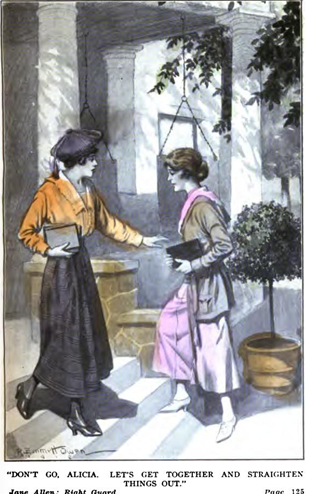
Jane Allen #2, Jane Allen, Right Guard


This year, Jane Allen is glad to be returning to Wellington College and Madison Hall. However, some spiteful person (I wonder who?) has written ahead to tell Mrs. Weatherbee that she won't be needing her room. By the time Jane arrives, it's been given to an unpleasant freshman, Elsie Noble, who is Marian's cousin. Jane and Mrs. Weatherbee sort it out, but Judy has by then christened Elsie, "the ignoble Noble." The ignoble Noble lives up to her name by circulating a petition among the freshmen to have them refuse Jane and her friends as escorts to the freshman dance. Luckily, the girls find four "poor" girls who are willing to have them. I'd describe them, but they're barely mentioned again, so why bother?


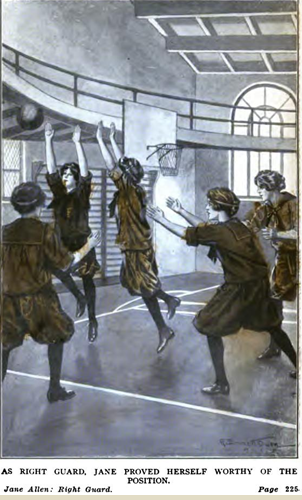
Basketball is even more of an afterthought in this book than the first one. Jane and Adrienne make the team handily, but Judy's place is taken by Marian, who has bribed two of the judges with limo rides and dinners at the Rutherford Inn. However, with Dorothy resigning as judge and the freshman team resigning their positions unless Dorothy's reinstated, Marian is soon forced to tender her own resignation. Jane plays Right Guard, which is supposed to also be a metaphor for her always being on the side of right. Gag.


To retaliate, Marian orchestrates this elaborate plot to implicate Judy as a kleptomaniac, with Norma and Jane covering for Judy. The basis for this is a conversation Marian overhears at the dance, involving Judy somehow taking another girl (who has since left to be married)'s white lace dress. I'd tell you more about it, only we're never really told, and it's quite confusing. In the end, Mrs. Weatherbee's eyes are opened to Marian's true nature, with the assistance of the formerly ignoble Noble, and Marian and Maizie are no longer welcome to return to Madison Hall the following year.

  • I was really intrigued by the character of Maizie Gilbert up until the end of this book. She's not motivated by petty emotions like Marian is, and she's not exactly a weak character who just follows Marian's wishes. Instead she's portrayed as almost a lazy sociopath?
  • "I don't pretend to understand myself," returned Maizie tranquilly. "It would be too much trouble to try. Besides, self-analysis might be fatal to my comfort. I might dig up a conscience, and that would be a bore. I'd rather take it easy and smile and be a villain still. Changes are so disagreeable. You'd find that out, if one came over me. You'd be minus a valuable ally." See? There's self-awareness there, but no real conscience.
  • Maizie has "unfathomable" black eyes.
  • "It strikes me," drawled Maizie, "that there's been altogether too much of this 'paying back' business. You'd best drop it, Marian. You're not a success in that line." Jane and her friends are too kind to have any truly entertaining criticisms of Marian. Maizie has no such qualms.
  • "She's a strange girl, Judy. There's a lot to her beneath that lazy, indifferent manner of hers."
  • Of course, in the end, Maizie is converted to Jane Allen's goodness. I, for one, was disappointed.
  • The sophomore team has khaki uniforms, as a nod to patriotism. This is the only mention, however oblique of WWI in the series thus far.
  • The ebook is available here. Love the illustrations, even if one seems to be missing from this copy. They're by R. Emmett Owen. I haven't seen the first title's illustrations, but they're by Roy L. Williams

Tuesday, December 28, 2010

Jane Allen #1, Jane Allen of the Sub-Team


The Jane Allen College Series is, not surprisingly, about Jane Allen's life at Wellington College.

Jane Allen of the Sub-Team introduces Jane, who is 16 at this point, her father, Henry, who is a wealthy (natch) Montana rancher, and her spinster Aunt Mary, who has moved in with them after the death of Jane's mother ("Dearest," aka Dorothy) when Jane was 12. Is there any greater predictor of mortality than being the parent of a series heroine? Apparently it was Jane's mother's dying wish that she be educated at Wellington Seminary, which is now Wellington College. Jane is a spoiled tomboy who HATES the idea of going east to school. HATES.

Jane has never had girl friends her own age and can't see the point of courting them. She's rude and stand-offish, with a terrible temper. I enjoy having an imperfect heroine, but Jane at this stage is pretty much unbearable. Of course, with the encouragement of her roommate Judy Stearns and other friends, she eventually becomes more pleasant and makes friends. For a series whose gimmick is basketball, it's not introduced at all until the sixteenth chapter and isn't really a focus of the plot, which suits me just fine. Anyway, with some strategic injuries, illnesses, and resignations, Jane eventually makes the main team and leads them to victory over the sophomores.
  • "Once she was imprisoned in that hateful seminary she would die. Her father and Aunt Mary would be sorry. She pictured herself slowly dying of grief and homesick longing. Some day, soon after they sent her away, a telegram would come to El Capitan. Her father would open it and read, 'Come at once. Your daughter died last night.' Then, when it was too late, they'd understand. Jane wept afresh in sheer sorrow for her untimely end." I wish the whole book were as funny as this passage implies.
  • Jane has a portrait of "Dearest," to whom she talks. Dearest is her inspiration to do good.
  • Jane reads a book series, Beatrice Horton's _____ Year at Exley (First through Fourth years), on her way east. For the record, it doesn't really exist, but I'm entertained by the whole meta aspect.
  • She meets the series enemy, Marian Seaton on the train east. Her main flunky is Maizie Gilbert, and while she has others, they eventually defect. Seriously, over the course of the series, Jane inspires more conversions than a messianic figure.
  • She lives at Madison Hall, under the auspices of Mrs. Weatherbee. Mrs. Weatherbee messes up the room assignment, and she and Jane haven't resolved their differences by the end of this book.
  • Friends and character traits: Judy (bizarrely absent-minded), Dorothy Martin (benevolent/saintly upperclassmen), Adrienne Dupree (elfin daughter of French dancer), and Norma Bennet (poor girl working her way through Wellington waiting tables at Madison Hall).
  • In old books like this, girls have "crushes" on each other, not on boys. They also invite each other to dances. I know Clair Blank hadn't been to college when she wrote the Beverly Gray books, but I wonder who had the boys at dances bit correct.
  • They have a Morris chair in their room.
  • The Rutherford Inn is their off-campus gathering place.
  • Jane is tall, with auburn hair, grey eyes, and a size 5A foot. This is my own coloring, which I've always thought was relatively uncommon, but which fits at least one character in about every series.
  • The series does have some fashion descriptions, but I'm not a huge fan of 1910s style, honestly.

Tuesday, May 5, 2009

C&L Mystery Stories for Girls #1, The Jade Necklace


Roslyn Blake is the orphaned child of a scientist/explorer and a mother who died when Roslyn was four. Since her father's death, she's been under the guardianship of the Chiltons, consisting of the horrid father, the lovely mother, sweet and beautiful daughter Muriel, and son Bob, the wannabe inventor. Roselyn's ambition is to be a professional pianist, but Mr. Chilton appropriates her personal funds that she was to use for lessons to buy this folly of a house, Belleview, out in the country.

Almost as soon as they get there, they're put upon to host a Chinese lord (Mr. Wang), his valet Hop Kee (and the valet's pet monkey), and his older friend/advisor (Mr. Han). Roslyn has a snuff bottle and what she believes to be an imitation jade necklace, both posthumous gifts from her father. The latter disappears, and she alternately suspects Hop Kee and his monkey. She thinks she's recovered it from the room of Mr. Wang (placed there, she believes, by the monkey), but she's actually stolen the real thing that her necklace imitates. Oops.

In the end, Mr. Chilton moves to New Zealand, to sponge off of his wealthy cousin; Mr. Wang (who is half-American, the son of the former owners of the house) proposes to Muriel and buys the house from Roslyn for his mother--giving Roselyn the money for piano lessons; and Bob goes to University, courtesy of his aunt. The necklaces are each restored to the appropriate owners.
  • Roslyn keeps telling herself that she'll be of age in three years. I'm not sure if "of age" means 18 or 21, therefore I'm not sure if she's 15 or 18. Whichever, Muriel is 4 years older.
  • I've read far too many Agatha Christie novels. I've been conditioned to believe the brother and the adopted daughter will always fall in love and was sadly disappointed/honestly confused when this didn't happen. I mean, they call each other Bobsy and Rosey!
  • The Honorable James Chilton is really almost TOO bad. He's unpleasant to read about, and it was distracting to be thinking things like, "How's Pem going to get out of this one? Killing him? How?"
  • That said, Pem does give you some insight into the guy. He's been disowned by his wealthy British family, and he thinks he knows more about money than he does. He enjoys the misery of others, especially if it's directly controlled by him. He makes Muriel wretchedly embarrassed by his matchmaking efforts with Wang--reading about it made me just wince in sympathy.
  • There's definitely some racial stuff in this book about the Chinese. Think "How do they even see through those eyes!"
  • Pem is just so good at writing about emotions and feelings, with a mixture of showing and telling. Roslyn's passion for music, her love for her adoptive family (especially her relationship with Bob), and her frustration with Mr. Chilton and his use of her money come across as being very genuine.
  • The family's pet name for Muriel is "Mew," which I think is rather cute.
  • Roslyn wears"the old yellow silk that had come from Bangkok and the gold woven band that had been a savage's bracelet," while Muriel has a "soft green" gown with "rhinestone fringes." Mrs. Chilton wears"coral sequins," and other guests at a ball wear a "mound of pink satin," a"beaded cerulean crepe," and a girl has a gown of "flaming red, with sparkling heels to her red velvet slippers and a huge red ostrich-feather fan."
  • Finally, this story takes place in a fictional town in Pennsylvania, where Pem was from. Bob goes to Lehigh University in the end, and Mrs. Chilton moves with her sister to Clinton, which is near Pittsburgh.
It's hard to explain why I like this so much--all I can say is that it's in the details. Highly recommended. Next up, The Thirteenth Spoon.

Tuesday, April 28, 2009

Brad Forrest Adventure Series, #5, 6, & 8


I purchased this set of books on a whim--the description sounded like good potential for the ridiculous, a la Christopher Cool. And while they're nowhere near Chris Cool levels of amazing, they're pretty campy. They're also extremely short--I can put one away in about 35 minutes. It was written as a Canadian series (a bit unusual) with eight volumes published in 1965, along with what are believed to be eight ghost volumes. Each title is in the format of Brad Forrest's Location Adventure. New York Adventure deals with heroin smuggling/the UN (yes, really), Yucatan Adventure is about Latin American revolutionaries, and London Adventure is a classic Cold War/defected/kidnapped scientist plot.

The front of each book has what sounds bizarrely like a brief bio for a company newsletter, which I believe I must reproduce in full.

"Bradley Raymond Forrest was born in Ottawa but he grew up in Toronto where his father's newspaper empire has its headquarters. Mr. Forrest owns a farm in Quebec and a Montreal house, so during the holidays, Brad learned to speak French fluently.

He is taking political science at the University of Toronto, and he plays hockey, golf, and football; he is keen on skiing and small-car [as opposed to large-car?] racing and, as a flier, he has his multi-engine ticket. Hunting and skeet shooting have made him a fair shot, and mountain climbing, skin diving and riding have kept him very fit. Although Mr. Forrest is very wealthy, he believes that his son should earn his holidays, so Brad has done all sorts of jobs in the newspaper business when not engaged in disentangling himself from his many fascinating and sometimes [no, always, trust me] dangerous adventures."

I mean, really. The awkward changes in tense, the random punctuation, the never-ending sentences . . .
  • Brad has NOT done all sorts of jobs in the newspaper business. He has been sent to multiple locations to do such things, but inevitably ends up involved in international intrigue. Furthermore, his dad's job activities are described more as a diplomat than a news tycoon.
  • There's never any explanation of the non-existence of Brad's mother. I assume she's dead, but it's not stated in any of these three volumes.
  • Why is it almost never a dead FATHER? I guess it ruins the whole "must be rich enough to go on constant expensive adventures" thing.
  • The wealthy blond athlete is in a frat. I know you're shocked. There's just as many mentions of him doing school work as there are of him doing newspaper work. AKA none.
  • Girls are not mentioned AT ALL in these books. A little weird, considering he's supposed to be 18, good-looking, great guy, tons of money. While they're short (younger audience?), there's plenty of violence (older audience?), so I'm not sure why.
  • He also doesn't have a chum. Instead, he has a different secondary helper character in every book. So another oddity. Brad Forrest has issues with close relationships?
  • I swear, this boy kids kidnapped/held captive more than Nancy Drew. We're talking multiple times per book.
I really wish the ghost titles had been published, particularly the adventures in Toronto, Nassau, and Anchorage. Of the existing titles, I wouldn't mind getting my hands on Madagascar, Calgary, and Hallifax. Speaking of fatherless main characters, my next review will be one of the Lilian Garis Books for Girls, Nancy Brandon.

Tuesday, April 7, 2009

Mildred A. Wirt Mystery Stories #1, The Clue at Crooked Lane

Mildred Wirt Benson is best known as a ghostwriter for the Nancy Drew series. However, she was extremely prolific and wrote for many other series, such as Ruth Fielding, Dana Girls, and Kay Tracey, as well as several titles in her own name. One of these series is the Mildred A. Wirt Mystery Stories, published by Cupples and Leon in the 1930s, of which The Clue at Crooked Lane is the first.
There's no illustrator listed, but the expression on Peggy's face reminds me of the early Tandy artwork for Nancy Drew. Something about the profile and the tucked chin, looking up.

The Clue at Crooked Lane fulfills pretty much every series book stereotype ever: amnesia, missing person, missing will, a secret drawer, gypsies, a miser, motherless girl with motherly housekeeper. It's all very Mildred Wirt. The motherless girl in question is Margaret "Peggy" Palmer, the daughter of Major Palmer. Her best friend Rebecca convinces her to come with the other girls to a gypsy camp to get their fortunes told. While there, the police raid the camp, and the old gypsy gives a bracelet to Peggy. Naturally, it's the stolen property of an actress, and the police immediately accuse Peggy of stealing it. When the actress, Marilyn Marlowe (yes, really), is asked to identify Peggy as the thief, she does so, even though it's clear Marilyn has no clue who took it. Peggy is only released when her friends track down the old gypsy and get her to confess. She now has an enemy in Miss Marlowe, who was shamed before the police.

Peggy's Uncle Jack sells antiques, and she sometimes helps him unpack shipments. While doing so later that night, she discovers a secret drawer in a desk, which contains a locked onyx box. Her uncle says it needs to be returned to the original owner--it was purchased at an estate auction at Sleepy Hollow, some 100 miles north. She and Rebecca drive up the next day and meet Linda, the only person living on the estate. Her uncle Elias disappeared three years ago with a ton of money belonging to a charity and has now been declared dead. He left all of his money in an old will to a distant cousin, in spite of the fact that he had been caring for Linda for several years since her parents' death. Peggy is convinced that the onyx box must hold a newer will, and Linda promises to come down to visit Peggy and see the box.

The next day, Peggy discovers that a clerk has inadvertently sold the box to Marilyn Marlowe, who denies it when questioned. Uncle Jack sends her and Rebecca to pick up an old clock in the mountains, but they get a flat along the way. When they go for help, they stumble across an old miserly recluse living on Crooked Lane. He's kind, but clearly confused and not remembering his past. I'm sure you can guess who he is, but we've still got more than 100 pages to go. Peggy goes back to visit him weekly, because she's concerned that he's not eating, and she senses a mystery about him.

Linda comes in and is disappointed about the box. While with Peggy, they interrupt a hold-up at a jewelry store and get the police--the thief sees Peggy and promises revenge as he's captured. Peggy attempts again to get Miss Marlowe to give up the box, but she throws Peggy out. Peggy's solution? Breaking in to the house. Sweet. She has no luck with the box, but overhears two maids talking about it. Afterward, the gardener tells her that Miss Marlowe is at her mountain summer home. Conveniently, Rebecca's parents invite her and their friends to a house party up a their own mountain lodge. Peggy goes over for attempt #2. Again, Miss Marlowe tosses her out, and again Peggy breaks in. Just, wow. To throw in one more stereotype, she's forced to hide in a closet and is discovered. She escapes with the box, blows the fuses--which kills the lights, and absconds on a high speed automobile chase. For real. It's pretty amazing.

She turns in at Crooked Lane and discovers a robbery in process--the thief from earlier has escaped and is hitting the miser over the head. She leaves the box in the car and runs. The thief captures the miser and Peggy, but they gain control of his gun in struggle. She locks him in a wardrobe (see the frontis), but the miser has been injured. At this point, her friends are searching for her. Once found, they send for an ambulance and the police. Of course, the knock to the head causes the man's memory to return, and when Peggy asks if he's Uncle Elias, he says yes. The thief robbed him three years earlier and hit him over the head. He's had amnesia and the delusion that he must make enough money to make up the loss, which is why he's a miser. He and Linda are reunited, and Marilyn Marlowe, who is the distant cousin and has destroyed the will by now, gets absolutely nothing.
  • The book blatantly says, "Rebecca liked whatever Peggy liked. However, she found it difficult to keep up with her more energetic friend." This is almost always the definition of a secondary series book character, but I've never seen it so blatantly stated.
  • The book is very Nancy Drew in that, once the police find out who Peggy's father is, they immediately back off and are worried.
  • Uncle Jack has a Chinese cook named, I kid you not, Squint. Ouch. I have to admit a secret fondness for Chinese cook characters, though. The Adventure Girls at K Bar O, for example.
While there's no romance or fashion, The Clue at Crooked Lane makes up for it in adventure. The mystery is pretty lame--it's obvious to anyone who reads these kind of books who the miser is--but it's better written than most. I'm still on a hunt for good sleuthing chums, though! Next up, I did decide to go with an old favorite: Judy Bolton and Seven Strange Clues, to be followed by The Mysterious Half-Cat.
 
template by suckmylolly.com : background by Tayler : dingbat font TackODing