Showing posts with label review. Show all posts

Wednesday, February 2, 2011

Christopher Cool, Teen Agent #1: X Marks the Spy


Okay, the Christopher Cool, TEEN Agent series is my all time favorite boys series. I cannot tell you how much kitsch-tastic amazingness is contained in each volume. The series was published in 1967-69 by Grosset and Dunlap and written by Jim Lawrence (who wrote the newspaper strip version of James Bond, appropriately enough) under the pen name Jack Lancer. Chris is the son of Dr. Jonathan Cool, "America's foremost brain in high energy physics," who mysteriously disappeared a couple of years ago. Chris goes to the CIA at 17, hoping to get hired and go after his dad. Instead, he gets funneled into the TEEN (Top-secret Educational Espionage Network). Yes, I'm serious. Yes, it's fabulous.


Anyway, two years later, Chris is at Kingston (an Ivy League type college), rooming with his TEEN partner, Geronimo Johnson. Gerry is Apache, which is one of the fifty million languages that Chris speaks fluently. I won't deny that a lot of the Native American humor in this series is kind of cringe-worthy, but most of it's tongue-in-cheek and mocks the other characters, rather than Gerry. Q is their main contact from Control, dresses in a navy blazer and a yachting hat, smokes an unlit pipe, and takes constant swigs from a bottle of milk. Could I make any of this UP? I LOVE IT. The heroine (supporting character) is Spice Carter, a fiery redhead who can hold her own in intelligence and a fight. The villains alternate between the Reds (obvious Cold War influence in the series) and TOAD, which is a network of supervillains aimed on global domination. SQUEE!


In this first title, Chris and Gerry are off to France, in search of a secret weapon Ciel Assassin/Skykill. It's been developed by an evil genius, Le Glacier/the Chiller. Of course. They meet up with Spice Carter for the first time outside of Paris, and both boys are impressed with her, not just her looks, but mostly her skillz. To give you an example of a typical Chris Cool adventure, there's a fight scene on top of the Eiffel Tower, and Chris gets thrown over, goes into a skydiving roll, turns on the jet packs built into his shoes, then Gerry zips him a rescue line. Also typical: underground labs abound, with venomous attack bats. These books are PERFECTION.


This refuses to rotate.
Other things I like about this series: They're well-written, in spite of the ridiculosity of the plots. They talk a lot about cars and girls, which I think is realistic for a series targeting boys who are maybe 11-15. They're also heavy on gadgets, in the vein of James Bond. Pomeroy is the eccentric little bald man who keeps them suited up with bizarro supplies. Anyway, I HIGHLY recommend this series. It can be difficult to collect--it doesn't seem to have been as widely-printed as many series, and a lot of the titles duplicate other, more commonly available trade titles, which makes it hard to search for some of them. That said, most can be found for $5-10 with a little patience.
  • The story begins with a hot flash from Control via their wristwatches. I tried to keep track of the gadgets for this entry, but it was getting ridiculous. Rough list: chewing gum explosives, UV light rings, jet pack shoes, rescue lines, ties that adapt to gas masks.
  • "The 4.2 liter engine purred like a well-fed pussycat, then broke into a full-throated jungle roar as the black Jag shot down the driveway into Madison Circle." The Jag is their main car.
  • Q calls the CIA "Cloak and Dagger," which I found entertaining.
  • TOAD  sends toads to intended victims, and stamps the foreheads of victims with a bladed, venom-injecting stamp.
  • Sixties fashions abound, including a, "Gaunt horse-faced woman with dangling earrings and a brassy yellow fright wig."
  • When they talk about girls, they pretty flatly say whether or not they're hot. To me, this reads a lot more true to a typical 19 year old guy than most of these books.
  • Chris himself is of course hot, with blond hair, blue eyes, and a tight frame. Gerry is constantly described as having coppery skin and longish black hair. The book mocks those around them who give Gerry the side eye.
  • I apologize for how much squeeing fangirlness is in this post, but I seriously can't recommend these books highly enough. Guaranteed entertainment.

Monday, January 10, 2011

Jane Allen #5: Jane Allen, Senior


Someone has added the above annotation to the scanned copy on Google. And luckily, it's quite true--this book is compulsively readable and the best of the series. This year, Jane has decided that she and Judy must go in for that specialization in social work, complete with 200 hours of field work. Judy hauls in truant boys, while Jane takes on the Jennings/Castbolt family. Mrs. Jennings is a young widow with two baby children, living with her also-widowed mother, Mrs. Castbolt. They're eeking out a living while Mrs. Jennings's brother/Mrs. Castbolt's son, Renny, finishes his final year of an engineering degree. Unfortunately, Mrs. Jennings has given their pittance of savings to Carol Dare, an "agent" of sorts, hoping to get on the stage and get more money for the family. Of course, this fails, and unless Renny drops out of school, they'll lose the house. Their only other hope is a wealthy uncle, who just HAPPENS to be Henry Allen's old friend.

While Jane manages to solve everyone's problems per usual, this book is much more fun as to what happens along the way. The girls take in the two babies to Madison Hall for a night, and Judy also has hilarious adventures with her "hooky boys." In another side plot, Judy has the school "adopt" an elderly man, who just happens to be the grandfather of Carol Dare. Honestly, it's not too far from the usual series book do-gooding, but doing it through the lens of social work makes it less cloying. Finally, this book has boys and romance! There's a prom, and Renny is a great romantic interest. He reminds me of Bill from the Patty Fairfield series, so far as the humbler origins/self-made bit. I really hate that the story ends with this title.

This book does raise interesting issues as far as the then relatively new idea of girls being in school at all, let alone actually pursuing a career. In one scene, the girls bemoan how being away at school hurts their chances with boys back home. They also give Jane a hard time as far as taking time away from sports and school fun to do her field work. Jane's father, especially, really is not into her taking on ANY job, let alone social work--he doesn't "want Jane to devote a promising young life to a restricted career." In the end, it turns out that he's asked their supervisor to restrict her to this case, since he's friends with the uncle. Jane, oddly enough, is okay with this. It's one of the many mixed messages this book gives. I wonder how the romance and career would have both been incorporated had the series continued--ideally in the vein of Beverly Gray, I think.
  • Social work "had only been recognized as a profession since college graduates were required by the Social Service promoters." The book is really interesting as far as info about the establishment and workings of Social Services. Very unique in a series book, to the best of my knowledge.
  • "But we have had the games all through our three years," is the only real mention of basketball in this book (refereeing is the only one in the last one, for the record), and it's offered as a weak protest to the girls field work. I will also point out that it's actually been four years--memory slip, or futher proof that Josephine Chase did not author the later titles?
  • Dozia tells a long, hilarious story based around wearing (and not wearing) stockings with a bathing suit and a misunderstanding with her fiance, Phil. It's worth reading, I promise! I can't condense it any better than that.
  • Mrs. Castbolt and her sister were both seminary grads, and they (and Jane) bemoan Mrs. Jennings decision to marry immediately after college, "Married the year she graduated! The clause repeated itself. Just imagine!"
  • "The fact that gentlemen were now permitted to come to Wellington and take part in the big social affairs, gave the zest that goes to make any affair interesting." Finally! An explanation of all the girls-only dances of the first three books.
  • It's too bad that there weren't boys until this book, because the writing about it completely captures schoolgirl crushes. "When he was gone, a few minutes later, Jane and Judith fell into each other's arms like two high school girls." None of Nancy Drew's nonchalance/disinterest here.
  • "Then he smiled down at her, and she felt so small--he was so tall and so protective. The two old friends were talking eagerly over near the window, and the young folks--well, they were not saying much just then. The air was tingling with interest, and Jane must have been very happy; for again 'youth will be served.'"Clearly, Renny was to be the romantic lead for the rest of the series.
  • "Was there anything else to be settled? If so it will have to be told in the next volume of this series to be entitled: Jane Allen: Graduate." :-(
  • Final count for things that were restricted to the first three books: basketball, no boys, and Marian Seaton. Carol Dare is the only real enemy of this volume, and she's not much of one. I hate enemies, so even more points for this book.

Saturday, January 8, 2011

Jane Allen #4, Jane Allen, Junior


Well, as I thought, this story doesn't resume the second semester of junior year. That semester will be forever lost to human history. Judy and Jane are juniors again, with the explanation of, "An extension course in special work kept Jane with her junior friends," or, "Judith and I decided on this extra year to specialize," in sociology. This doesn't mean much for this book, but it will for the next, so file it away. Anyway, they're juniors again (?), and the Allen scholarship this year has gone to an unfortunate, raw-boned country girl, Shirley Duncan, who's both obnoxious and gauche. The other "pet freshie" this year is Sarah "Sally" Howland.

Dol Vin (as she's now known) has opened her beauty shop of iniquity at the gates of Wellington, and Shirley and Sally seem to be somehow involved with her, although Sally's well-liked by everyone. There's also a ghost haunting Lenox Hall and scaring the poor little freshies, and some mystery surrounding Shirley and Sally. It turns out that Sally and Shirley have swapped identities at the suggestion of Dol Vin, who taught them in gym--the real Shirley ("Kitten") needs money to send her brother Ted back to college and sells her scholarship to Sally ("Bobbie"), who, while brilliant at math, is unable to pass the other subject exams to get into college. Of course, in the end, Bobbie makes nice with Jane and her friends, and Shirley's father's fortunes are reversed, so they're both able to stay at Wellington. Because the dean is willing to overlook multiple fraudulent elements in light of good intentions.

  • The first proof of Bobbie's awfulness: "She was garbed in a baronet satin skirt of daring hue with an overblouse of variegated georgette. This as a school frock!"
  • Sarah Howland is considered a "most atrocious name." I'm sure I don't see how. Apparently Sarah is "old fashioned" and "country."
  • Bobbie is forced to dust Dozia's room with a feather glued to her nose as her freshman initiation. When the girls clean her up afterward, she refuses to let Jane brush her hair with a damp brush. "Not wet it?" she [Jane] thought quickly. "That must mean treatment, and treatment meant the forbidden beauty shop!"
  • More classless dressing, on Vin's part this time: "She was gowned in a very close fitting and striking black satin 'clinger' gown. Her hair was done in the most modern of styles, like a window show for her hair dressing parlor, and her foreign face, with its natural olive tones, was very much fixed up with many touches of peach and carmine, as well as darker hints under the eyes; and her lashes--well, perhaps Dolorez had been crying inky tears; that was the effect one gathered from a glance at the vampish make-up."
  • The Project Gutenberg text repeatedly refers to "Jane Alien." Can you imagine? It makes me think of the whole Pride and Prejudice and Zombies business.
  • There are boys at dances now! Judith is, of course, more interested than Jane in this. Series heroines are never allowed to be interested in boys or romance, only sidekicks.
  • I'm completely lost now on the authorship of these books. The missing time is a pretty glaring inconsistency, but this book continues the new cast of characters from the previous book.


Wednesday, December 29, 2010

Jane Allen #2, Jane Allen, Right Guard


This year, Jane Allen is glad to be returning to Wellington College and Madison Hall. However, some spiteful person (I wonder who?) has written ahead to tell Mrs. Weatherbee that she won't be needing her room. By the time Jane arrives, it's been given to an unpleasant freshman, Elsie Noble, who is Marian's cousin. Jane and Mrs. Weatherbee sort it out, but Judy has by then christened Elsie, "the ignoble Noble." The ignoble Noble lives up to her name by circulating a petition among the freshmen to have them refuse Jane and her friends as escorts to the freshman dance. Luckily, the girls find four "poor" girls who are willing to have them. I'd describe them, but they're barely mentioned again, so why bother?


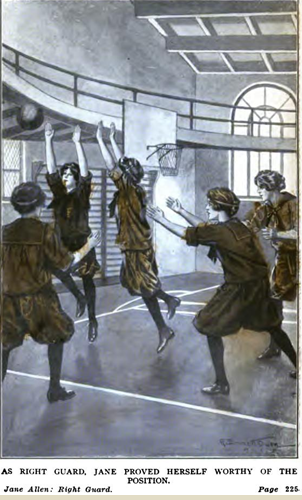
Basketball is even more of an afterthought in this book than the first one. Jane and Adrienne make the team handily, but Judy's place is taken by Marian, who has bribed two of the judges with limo rides and dinners at the Rutherford Inn. However, with Dorothy resigning as judge and the freshman team resigning their positions unless Dorothy's reinstated, Marian is soon forced to tender her own resignation. Jane plays Right Guard, which is supposed to also be a metaphor for her always being on the side of right. Gag.


To retaliate, Marian orchestrates this elaborate plot to implicate Judy as a kleptomaniac, with Norma and Jane covering for Judy. The basis for this is a conversation Marian overhears at the dance, involving Judy somehow taking another girl (who has since left to be married)'s white lace dress. I'd tell you more about it, only we're never really told, and it's quite confusing. In the end, Mrs. Weatherbee's eyes are opened to Marian's true nature, with the assistance of the formerly ignoble Noble, and Marian and Maizie are no longer welcome to return to Madison Hall the following year.

  • I was really intrigued by the character of Maizie Gilbert up until the end of this book. She's not motivated by petty emotions like Marian is, and she's not exactly a weak character who just follows Marian's wishes. Instead she's portrayed as almost a lazy sociopath?
  • "I don't pretend to understand myself," returned Maizie tranquilly. "It would be too much trouble to try. Besides, self-analysis might be fatal to my comfort. I might dig up a conscience, and that would be a bore. I'd rather take it easy and smile and be a villain still. Changes are so disagreeable. You'd find that out, if one came over me. You'd be minus a valuable ally." See? There's self-awareness there, but no real conscience.
  • Maizie has "unfathomable" black eyes.
  • "It strikes me," drawled Maizie, "that there's been altogether too much of this 'paying back' business. You'd best drop it, Marian. You're not a success in that line." Jane and her friends are too kind to have any truly entertaining criticisms of Marian. Maizie has no such qualms.
  • "She's a strange girl, Judy. There's a lot to her beneath that lazy, indifferent manner of hers."
  • Of course, in the end, Maizie is converted to Jane Allen's goodness. I, for one, was disappointed.
  • The sophomore team has khaki uniforms, as a nod to patriotism. This is the only mention, however oblique of WWI in the series thus far.
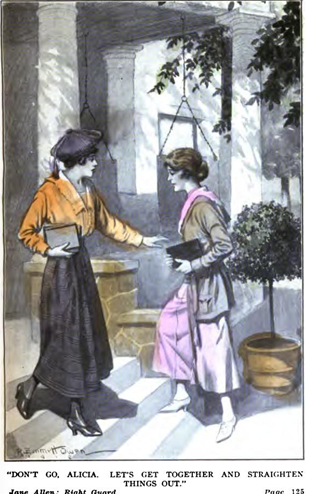
  • The ebook is available here. Love the illustrations, even if one seems to be missing from this copy. They're by R. Emmett Owen. I haven't seen the first title's illustrations, but they're by Roy L. Williams

Tuesday, December 28, 2010

Jane Allen #1, Jane Allen of the Sub-Team


The Jane Allen College Series is, not surprisingly, about Jane Allen's life at Wellington College.

Jane Allen of the Sub-Team introduces Jane, who is 16 at this point, her father, Henry, who is a wealthy (natch) Montana rancher, and her spinster Aunt Mary, who has moved in with them after the death of Jane's mother ("Dearest," aka Dorothy) when Jane was 12. Is there any greater predictor of mortality than being the parent of a series heroine? Apparently it was Jane's mother's dying wish that she be educated at Wellington Seminary, which is now Wellington College. Jane is a spoiled tomboy who HATES the idea of going east to school. HATES.

Jane has never had girl friends her own age and can't see the point of courting them. She's rude and stand-offish, with a terrible temper. I enjoy having an imperfect heroine, but Jane at this stage is pretty much unbearable. Of course, with the encouragement of her roommate Judy Stearns and other friends, she eventually becomes more pleasant and makes friends. For a series whose gimmick is basketball, it's not introduced at all until the sixteenth chapter and isn't really a focus of the plot, which suits me just fine. Anyway, with some strategic injuries, illnesses, and resignations, Jane eventually makes the main team and leads them to victory over the sophomores.
  • "Once she was imprisoned in that hateful seminary she would die. Her father and Aunt Mary would be sorry. She pictured herself slowly dying of grief and homesick longing. Some day, soon after they sent her away, a telegram would come to El Capitan. Her father would open it and read, 'Come at once. Your daughter died last night.' Then, when it was too late, they'd understand. Jane wept afresh in sheer sorrow for her untimely end." I wish the whole book were as funny as this passage implies.
  • Jane has a portrait of "Dearest," to whom she talks. Dearest is her inspiration to do good.
  • Jane reads a book series, Beatrice Horton's _____ Year at Exley (First through Fourth years), on her way east. For the record, it doesn't really exist, but I'm entertained by the whole meta aspect.
  • She meets the series enemy, Marian Seaton on the train east. Her main flunky is Maizie Gilbert, and while she has others, they eventually defect. Seriously, over the course of the series, Jane inspires more conversions than a messianic figure.
  • She lives at Madison Hall, under the auspices of Mrs. Weatherbee. Mrs. Weatherbee messes up the room assignment, and she and Jane haven't resolved their differences by the end of this book.
  • Friends and character traits: Judy (bizarrely absent-minded), Dorothy Martin (benevolent/saintly upperclassmen), Adrienne Dupree (elfin daughter of French dancer), and Norma Bennet (poor girl working her way through Wellington waiting tables at Madison Hall).
  • In old books like this, girls have "crushes" on each other, not on boys. They also invite each other to dances. I know Clair Blank hadn't been to college when she wrote the Beverly Gray books, but I wonder who had the boys at dances bit correct.
  • They have a Morris chair in their room.
  • The Rutherford Inn is their off-campus gathering place.
  • Jane is tall, with auburn hair, grey eyes, and a size 5A foot. This is my own coloring, which I've always thought was relatively uncommon, but which fits at least one character in about every series.
  • The series does have some fashion descriptions, but I'm not a huge fan of 1910s style, honestly.

Wednesday, November 10, 2010

Betsy Hale


I could make excuses and promises related to the extended absence, but why not just jump back in?


One of the series that I set about acquiring when I discovered Pemberton Ginther is Betsy Hale. There's not a lot of information about the series out there, so much of this is my own speculation. It seems to have been released in three volumes in 1923 as a breeder set of sorts by John C. Winston and Co., who also published her more popular Miss Pat series.


While the books are somewhat scarce in dust jacket (it took me about a year and a half to get all three), there's little demand. I believe I paid less than $5 for the first title (Betsy Hale), $7.50 for the second (Betsy Hale Tries), and $8.00 for the third (Betsy Hale Succeeds). For me, it was hardest to find the last title, but right now it's the only one to be found on eBay. One book is dated 1924 and another 1928, which indicates they might have been in print for at least a few years. However, the dust jackets are all identical except for the titles, with the exact same ads and lists on each one, so maybe there was one printing which took awhile to sell?


The books have green and gold boards, and the dust jacket art is the same for all three volumes. I'm uncertain as to who did the dust jacket artwork, but Pem herself did the frontispiece and three internal illustrations for each book. The paper quality is quite good, and the stories range from 254-269 pages each. I will note that the frontispiece for my copy of Betsy Hale seems to be incorrect--it's one of the internal illustrations for Betsy Hale Succeeds.


At the beginning of Betsy Hale, Betsy is an imaginative and earnest 13 year old girl who has just moved with her widowed mother to Wee Corners, a small cottage that they've inherited in rural New England. Her mother is an author, in the vein of Jess's mother in the Girls of Central High series. In other words, they have no money, and Betsy is often left to assume household duties, financial worries, and generally fend for herself. Her primary friends are Emma Clara, Selma, and Philip, who is groomed, in my opinion, to be the future love interest of the series. The central conflicts in the book center around Mrs. Hale regaining her health, publishing a novel, and becoming financially stable.


In Betsy Hale Tries, the plot is based around trying to raise funds to establish a hospital in their small community, a venture spearheaded by Betsy and Philip. Along the way, Betsy makes a friend of Miss Willie, an eccentric older woman, and the family acquires Lucy as cook/housekeeper. Lots of themes of post WWI patriotism in this book, and there's a side plot involving a traveling circus.


I have no idea why the third book is titled Betsy Hale Succeeds. The plans of the last book have already succeeded, and this book is about how Betsy and her mother take in an alleged war orphan from France, Aimee. Of course, Aimee's parents are both alive in the end, her mother somehow ending up in some nearby town (from France. Really.), while her father had amnesia and a couple of amputations (final tally: one hand and one leg). The series ends with no references to phantom titles or future plans.
  • I really didn't care for the character of Mrs. Hale. She's clueless about household chores and is one of those people in old stories that has to have complete rest and no worry or she'll have a breakdown. Wonder why the non-genteel poor never get those orders? Beyond that, she offers no emotional support to Betsy.
  • Her mother has gotten them involved with a League of Truth and Simplicity after Betsy's father's death. So Elizabeth is now Betsy and has to wear brown sack dresses. I may be misreading, but I also think that Mommy Clueless loses a lot of money to them.
  • Luckily, friends take pity on Betsy and gift her with a "lovely limp yellow frock" and a pink lawn dress.
  • I really love Philip's character. His father is really sick in the first book (he eventually dies), and Betsy finds him crying hidden in the woods. She doesn't reveal herself, just has more sympathy and respect.
  • Betsy can't get Philip to come visit another girl with her, because, "I don't play with girls." When she reminds him that they've gone off in the woods twice that week, he says, "You're different." Aw.
  • Betsy is almost 15 at the end of the series. I think I would have enjoyed a continuation of the series, with more grown up themes. The target audience is probably about 12 for the books that were written.

I have mixed feelings about this series as a whole. I think it's well-written for a pre-teen age group, and Betsy is a likeable heroine. She has negative emotions and needs help to pull off schemes. She's not perfect. That said, I think I'd prefer an older heroine, stronger plotlines, and snappier/funnier dialogue. I'm building collections of the Hilda and Miss Pat series, which I'm hoping will be more to my liking. I've also tracked down the Macrae editions of The 13th Spoon and The Jade Necklace to share with you.

Tuesday, August 18, 2009

Polly Brewster #5, Polly's Business Venture


Yay! This book was fortunately a huge improvement over the last one--even if I still don't much like Polly herself. The girls all come back to New York and are immediately invited to a party on Mr. Dalken's yacht. Polly gets her invite from Tom, which makes her blush--yes, the ice queen isn't utterly indifferent. Anne's counseled him that he must be brotherly and patient until Polly's had her fill of her career, but of course he follow this approximately 10-15% of the time. He does convince her to walk with him on the yacht, where they're promptly swept overboard after a collision. He saves her life, for which she's grateful, but basically she continues in a mix of being scared by his feelings for her, annoyed by his attentions, and being oblivious to him.

Supposedly Polly and Nolla are to work in the mornings in Mr. Ashby's shop, continue to take classes in the evening, and acquire antiques on runs out to the country in Mr. Dalken's chauffeured limousine. In reality, the first two are NEVER depicted once, while several chapters are devoted to the latter. Of course, the girls habitually discover priceless relics for ridiculous prices, while the writing mocks the ignorance of the sellers. I love doing this sort of thing in real life, but this is easily the least thrilling portion of the book. The girls also spend a goodly portion of their time on night life, considering how busy they're supposed to be. Polly manages to acquire yet another swain in Jack, the protege and ward of Mr. Dalken.

It's fortunate that the girls have such luck at finding valuable antiques, because another landslide has buried their mine back in Pebbly Pit. This is doubly bad, because pretty much all their friends have invested in it as well, which makes Polly feel really guilty. Mr. Alexander from the last book comes to the rescue by shipping out to Pebbly Pit to see if he can uncover the mine again. The girls also offset their expenses some more by taking on some decorating jobs, one from Jack, and another from Mrs. Courtney, a wealthy, wise, and dignified divorcee. Guess who else is getting divorced? Mr. Dalken, whose wayward wife has found someone else she wants to marry. Hmm, I wonder what the girls will think to do with these two deserving middle-aged single people?

There's plenty of other romance in this book. At one point, when Tom is ill, Polly says she'll marry him in two years, if she hasn't found anyone better--harsh, but better than anything else she's said. I'm thinking that she's finally being reasonable, as it's obvious that she prefers him, plus John and Anne were engaged for two years. Of course, it's like Patty's promise to Mrs. Van Reypen in Patty's Fortune, and she ends up recanting, to my annoyance. Nolla and Paul continue along in their generally less melodramatic/more pleasant fashion--Nolla tells him that she's going to have her career first, then they can form a partnership. In the meantime, they can enjoy each other. Why can't Polly be that reasonable?

At the end of the book, Mr. Dalken invites everyone, including Mrs. Courtney, on a year-long yacht trip to the Orient. I know Jennifer has speculated on where Clair Blank got her inspiration for the Beverly Gray series, and it seems to me that Polly Brewster would have to be thrown in with those sources. I mean, career girls take extended yacht trip with lots of boys to the East? We'll see how it matches up in the next few books. I've now finished all the free titles available, so you guys will get a change to catch up on my incessant posting while I wait for media mail to take its course.

  • When Dodo sees Polly blushing over Tom's telegram, Dodo thinks that she, "had hiterto firmly believed Polly to be a man-hater." You and me both, Dodo.
  • Tom is described as being "unsophisticated with girls." He's finally stated to be "almost twenty-four" (to Polly's "nearly eighteen"); he's handsome, wealthy, out in society, etc. How is he unsophisticated?
  • Speaking of Tom's age, Jim is now said to be "about the same age as Polly," e.g. eighteen. This can't be true, unless he was done with one year of college and working on a mining crew at age fourteen.
  • Kenneth is said to be the handsomest. Then he and Jim pretty much disappear. As does Dodo, for the record
  • While he drives me a bit crazy, I think Tom's emotions on Polly's return are well-written by Lillie. He's built the whole thing up too much, and she's scared and avoids him. He ends up really depressed and berating himself, telling himself that he's too old (well . . . ) and unappealing and so forth.
  • Tom is encouraged by Anne (acceptable), his family (acceptable), and John (what!). This may be a more modern sentiment, but does a guy really encourage his best friend to pursue his underage sister?
  • Once every book, there will be a footnote indicating that the particular story being told is true. In this case, it's one of the antique-finding stories.
  • When they're rescued by Liberty Island, Polly and Tom are revived by the Schaefer Method, which is an old method of CPR done when prone.
  • Both Nolla and Polly can be impulsive and get carried away at times. The difference is that Nolla's intentions are always good when this happens (trying to make people like Polly, trying to get Polly and Tom together), while Polly's are petty and vengeful (at points she'll manipulate a situation or say things to purposely be hurtful to Nolla and Tom).
  • I've been trying to figure out Polly's appeal to guys, and apparently it's supposed to be that she's both beautiful and completely disinterested in guys, which piques their fancy. It might work for the guys, but it's not doing it for me.
  • Nolla is frequently shown to be the only person to understand something about Polly or to do her kindness. Polly isn't shown to reciprocate, which I think affects the believability of their friendship.
  • While this series reminds me a lot of Patty Fairfield, I don't like it nearly as much. To me, Tom lacks both the appeal and control of Bill, while Polly lacks the fun, the likability, and the grace of Patty. Patty doesn't want a real suitor, so she laughs them all off till she's ready, and they all deal with it. Polly's unable to deal gracefully with all the men who are interested in her, and ends up hurting Tom pretty frequently. In turn, Tom provokes Polly constantly, because he can't be patient and careful with his feelings.
  • Also, Polly has no regard for Tom's feelings--she's never, "Oh, this great guy loves me, I should feel honored and treat him respectfully, even if I don't return his sentiments." Instead she's annoyed and disdainful.

Monday, August 17, 2009

Polly Brewster #4, Polly and Her Friends Abroad


I have to say that this is my least favorite Polly book so far. The plot is both boring in itself, as well as being an extremely more boring version of the three book European vacation arc in Patty Fairfield. I think my main issue is that this series' strength is in its supporting characters, who, save my girl Nolla, are all back home in the States, and most of the newly introduced characters are either unpleasant or blah.

The book starts off with Polly, Nolla, the Ashbys, and Mr. Fabian crossing the Atlantic and arriving in Dover. They meet up with Mr. Alexander, a folksy, self-made Western millionaire--how many veins of gold ARE there in Denver, by the way?--his twit of a wife, Mrs. Alexander, and his daughter Dorothy, who has the unfortunate nickname of Dodo. Mrs. Alexander's goal is to marry Dodo off to an impoverished title, but of course, Dodo decides she'd rather follow in Polly and Nolla's footsteps and become an interior decorator.

Once in Dover, they meet up with Mrs. Fabian and their daughter Nancy, who are both pleasant and devoid of personality. They have been staying with Sir Charles Osgood, his wife, and their children, Angela and Jimmy. All of them are unpleasant and devoid of personality. Mrs. Alexander fails in marrying Dodo off to Jimmy, and they're off to the Continent. They meet up with at least one more titled man, Count Champys, but everyone returns to the US unmarried and with enough antiques (pottery and furniture) to furnish several mansions. Really, large portions of the book consist of them driving through the countryside and emptying the peasants' homes of Wedgewood and Sheraton tables.

Polly barely figures in this book--she has no important dialogue or conflicts, not that anyone else does, either. Her only development is to become more priggish. Even Nolla is a little bland. Dodo's only character trait is to occasionally have more Western speech. Ruth and Nancy are interchangeable, and, if left out, would not be missed. I could forgive the whole "nothing happens" bit, if only there was some witty banter or humor, but the whole book is very dry. Here's hoping Polly's Business Venture is better.

  • There's a decent amount of "patriotic" anti-German slurs, America's the greatest, rah-rah sort of thing. There's also some awkward religious references.
  • Mr. Alexander is supposed to be very charming and endearing with his lack of social polish and Western ways. I found him to be supremely annoying and constantly felt embarrassed for him.
  • They escape from an earthquake in Rome, which has innumerable strong aftershocks. This was a. inaccurate, I think, and b. so very boring.
  • This has been a theme in all the books, but Polly is jealous of anyone having a romance--not because she wants one, but because she wants John, Nolla, etc. to herself. This seems more than a little childish for a supposedly mature young woman.
  • Jimmy very annoyingly leaps around in his affection from one of the girls to another. When he sets on Nolla, Polly does what she does best and FREAKS. She pulls Nolla aside and honest to goodness threatens to write home to Paul and tell him that Nolla is a "dreadful flirt," and that his childhood friend Dodo is gorgeous and wealthy, and oh, he should totally marry her. Again, childish much. Crazy much, really.
  • Jimmy needs to marry for money. In a continuity error, Ruth is first stated to have a fortune, as the only daughter of the wealthy Ashbys, and later not to be desirable as a wife to Jimmy due to lack of money. Nolla and Polly have MORE money, so maybe he's just supposed to look MORE in their direction?
  • At this point, Lillie seems to have a pretty clear prejudice against low-born society wives, because Mrs. Alexander is a bit of hyper-annoying ridiculosity in the mold of Mrs. Dalken and Mrs. Maynard.
  • The people back home cease to exist. They're rarely mentioned, and the girls neither send nor receive letters or wires, save one letter apiece from Paul and Tom. I suspect this is why the book kind of sucks.
  • And finally, Dodo?! Really.

Polly Brewster #3, Polly in New York


So, Polly and Nolla head to New York to set up house with Anne and her mother, Mrs. Stewart. They lease a former carriage house/artist's studio, with the two girls being taken on as a project by the former leasee, Mr. Fabian. They take night classes with him, while going to Mrs. Wellington's school during the day. They make a frenemy in Elizabeth Dalken, a schoolmate, but when the girls rescue her from a fire (and NOW we head into series book stereotypes), they make friends. Moreso, however, they creepily befriend her father, Mr. Dalken and his friends, the Ashbys, who happen to be a an interior decorator, his wife, and their daughter Ruth, another one of the girls' classmates.

Jim and Ken are at Yale and happily run up to visit until warned away by Anne and Mr. Fabian, who insist that the girls need to focus on their studies. Tom helps the cause in his influence over his younger brother. Of course, Tom also anonymously sends Polly these ridiculous roses for Valentine's Day. There's also a Christmas visit with all the Evans, Latimers, Maynards (with brother Pete), and Stewarts (with brother Paul). They all spend the summer back in Pebbly Pit, where Polly's dad figures out the score with some hints from Nolla.

Back in the city, the girls find (I kid you not) a baby on their doorstep. The whole "mystery" with this is just ridiculous, along with their plans to "give" the baby to Mr. Dalken, whose son died several years ago. They're thwarted when the baby's believed-to-be-long-dead (in the war, no less) father shows up, but he takes a position in the Dalkens' apartment, so all is well. I mean, this would all be kind of awesome, but it does rather regurgitate a Patty Fairfield plot, which was in itself not at all unique.

In the end, John and Anne get married, and the Ashbys agree to chaperone the girls on their European adventure. Seriously, this series is SO Patty Fairfield/Beverly Gray in some ways (not that I'm complaining!). As the girls get on the boat, Tom confesses about the roses by leaving another bouquet in their cabin, signed, "Your Valentine that was, and is, and always will be, in this world, and in the next, and forever, Tom." Polly FREAKS, and honestly, it's much even for me, who normally eats this stuff with a spoon. The other girls convince this nincompoop that it's just a joke, and they're off to Europe.

I like this book, although I admit that it gets brownie points for me for reminding me so much of the Patty Fairfield books that take place in NYC. As the series goes on, though, I like Polly less, because she's both a Mary Sue and SO OBLIVIOUS IT KILLS ME. Just, argh, I know you're a simple country miss with a pure and noble heart, but do you have NO knowledge of human nature/NEVER notice anyone else's feelings? Argh. I continue to adore Nolla, though, who is just a ball. Nolla throws me for a loop by bailing on those romantic vibes with Ken, making some with Jim, then having a secret letter correspondence with Anne's brother Paul that's mentioned at the end of the book. Play on, Nolla.

  • Polly initially despises the city in this really annoying contemptuous way, mocking how in a hurry everyone is, the fashion, the crowdedness, etc. My girl Nolla loves it, of course.
  • Polly is offended by how, "Most every woman and girl I met had faces covered thick with layers of white chalk, with a daub of red on each cheek, and lips as scarlet as a clown's." Very 20s.
  • Polly is ridiculously provincial. She's never been in an automobile or used a telephone before. She's also never seen the ocean and says, "It's the only decent thing of which New York can boast."
  • At one point Anne pays a deposit in "yellow bills." I thought money was considered and referred to as green at this point?
  • My original timeline for the younger characters ages turns out to be completely off. Anne is described at the beginning of this book as, "just past 21," which means that Tom and John pretty much have to be 21 or older--especially when you consider that John is friends with Paul, Anne's brother, and unless they're twins . . . ? I'm now officially grossed out by 14 year old Polly and 21+ year old Tom. Ew. I forget that older school ages don't match up to modern ones/aren't as set in stone.
  • It's also said at the end of the book that the now 16 year old girls have surpassed the roughly 20+ years old Jim and Ken in maturity, due to their extra education. I guess this is why Nolla moves on to Paul?
  • Elizabeth Dalken is definitely more of a bad girl than ever appeared in Nancy Drew: "She could slyly cheat at bridge, smoke her mother's cigarettes, and flirt with the men who frequented her home, as well as her mother could." Mrs. Dalken is a terrible women who dared to leave her wonderful husband. She's the least sympathetically written character in the series by far.
  • At one point, the Polly and Nolla are accosted by young hoods walking home from their night art class. Before being rescued by Mr. Dalken, it's strongly suggested that the threat is sexual, and the scene is genuinely scary--very unusual for a series book.
  • Just so you know, Bob ends up engaged to some balding society aristocrat named Percival. Oh, Bob.
Still loving this series, but I need to sleep! Next up will be Polly and Her Friends Abroad, which is mistakenly referred to at the end of this book as Polly and Eleanor Abroad.

Polly Brewster #2, Polly and Eleanor


In the last book, Polly and Eleanor discover a long-lost gold mine. In this book, it's buried by an avalanche in the opening chapters. However, they don't give up hope of its being accessed, which conveniently allows Lillie to add in brother John, his attractive friend, Tom Latimer, his younger brother Jim, and Kenneth Evans, who is both working for a mining company with Jim and the (spoiler) nephew of the dead man who originally found the mine. Phew. I would have tried to explain this all more in the last review if I'd known they all crop up again.

Polly wants to access the mine because she wants money to go away to school. Her family's filthy rich, but her father is too desperately attached to his precious widdle Polly to allow her to leave the ranch. He also won't allow these beautiful glitter cliffs by the ranch house to be mined to finance the gold mine--again, to keep her at home. I'm really hating Mr. Brewster at this point. Fortunately, Nolla is over this ridiculosity and is a master planner.

Nolla (a.) gets her father to come to the ranch, hoping his bank will invest in the mine and that he'll let her go to New York with Anne, who's been offered a job in a girls' seminary, (b.) gets her mother to invite Bob to some posh camp-out, aka out of the way. Ken aids and abets by sending stones from the cliff to his father, who's invented some special polishing tool, and getting him to come out, too. Polly manages to aid her own cause by giving this impassioned speech on Girls of Today and needing to Experience the World and get an Education. If you need a hint on how all this turns out, the next book in the series is Polly in New York.

This book has ridiculous amounts of romance. Sary and Jeb get engaged, as do John and Anne. Anne's got to work the next two years, to put her brother through college (he's too proud to take John's money, but not too proud to let his sister "loan" him money from teaching school?), but then they'll be together. Until then, I suspect Polly and Nolla will have grand adventures under Anne's chaperonage. Polly and Nolla mostly hang with Ken and Jim, who I estimate at around 18 or so--one year of college under their belts, plus the last book guesses Ken to be this age. John and Tom are older, probably more in the 19-20 range, with two years to go of school, for the record. While I get some slight romantic vibes from Nolla and Ken, Tom has got it bad for the always-oblivious Polly--which Nolla is both amused by and encourages. I goofed and read a review for the final book, Polly Learns to Fly, and while I won't completely spoil it for you, Tom is the love interest for the rest of the series.

It's hard to tell from my summary (SO MUCH to cram into a few paragraphs), but this book was good to great. Great while I was reading it, in that I steamrolled right through it, if the times on my posts didn't clue you in. I fully plan to go right into the next one, as well. Good in that writing my post revealed that the plot meanders a good bit and is pretty silly as well. It reminds me of the early Beverly Gray books or Patty Fairfield in that sense--each book has multiple consecutive plots, and it's more about a period of time than anything.
  • This book has lots of unintentional ickiness. It probably speaks more about my juvenile sense of humor than anything, so I'll spare you most of it. Here's one example, though, Polly has "a graceful well-formed figure that was all the more attractive because of the charms her adolescence promised." *snickers about what charms we're speaking of* I told you it was silly. Sue me.
  • In the beginning, there's an Indian scout. Who speaks exactly like a Chinese cook character. As in, "Patsy good scout, too. Solly dem dead." Since when can American Indians not make an "r" sound?
  • Speaking of politically incorrect characters, there's a burro named N****r. Eek.
  • Fashion: the boys are coming for Sunday dinner. "Eleanor had loaned Polly one of her prettiest organdies, and had arranged her really beautiful hair becomingly. Silk stockings now encased Polly's shapely limbs, and her new low shoes looked twice as well with the sheen of silk above them." (side note: more unintentional ickiness twinges)
  • Bob, quite logically, tries to pair off with Tom, as they're the two loners in the crowd, and he's quite a catch. Unfortunately his opinion is, "Of all the empty-headed vain creatures it ever was my misfortune to meet, she takes the cake!"
  • Polly and Nolla are the same age (14), while Bob is older. Apparently old enough to be "out," want to get married, and to think Jim is too young, so I estimate 19ish?
  • I know the 14 year old Polly as a love object for 19 year old Tom should be considered gross/illegal by modern standards, but for some reason that doesn't generally bother me in old books. It actually does make me cringe a little in this case with all the references to her not precisely being post-pubescent.
  • Nolla's long term plan for her and Polly: "We propose going to Europe to study Italian, French, Spanish, and English periods and styles. If we have an extra year or so, to spare, we might go to Japan and Egypt." Based on the titles, I'm guessing most of these end up coming true.
  • Nolla's special failing is getting carried away and exaggerating, sometimes to the point of lies. Polly chews her out for this, and ends up reversing their position as friends--Polly becomes the leader. Honestly, this irked me, because I liked that the main character was the more passive one. Nolla and Mrs. Brewster are definitely my favorite characters, although I'd say that most characters are pretty likable.

Um, I'm going to wrap this up now, so that I can read the next book--a mark of a good book, no?

Sunday, August 16, 2009

Polly Brewster #1 Polly of Pebbly Pit


I've been interested but wavering over the Polly Brewster books by Lillian Elizabeth Roy for some time. They were published by Grosset and Dunlap over a ten year period from 1922-1932 and later some titles were reprinted by Whitman. Based on the titles, I believe they feature a lot of exotic locales and possibly a focus on adventure. I thought there was some serious Beverly Gray potential. However, the series doesn't seem to be that popular with collectors, even though it seems that it was pretty popular in its time and many titles are easy/cheap to find. It also has the same cover art for all titles. Finally, I decided to suck it up and look for the first title in a free ebook, to see if I thought it was worth collecting the series.

Marybelle "Polly" Brewster is the fourteen year old daughter of a rancher and his lovely, highly educated wife. They all live on an isolated ranch in Colorado. Polly has one older brother, John, who is away at college in Chicago. In the first chapter, Anne Stewart, a young woman who'd worked as a schoolteacher in their area/is the younger sister of one of John's school chums, writes to ask if she and two wealthy girls she is tutoring can board that summer at the ranch. Mr. Brewster agrees, on the condition that his wife allow him to hire help around the house. Sary, a recent widow, comes to work for them, and Anne soon arrives with the two girls: Barbara "Bob" and Eleanor "Nolla" Maynard.

There are all the expected culture shocks as the two girls adjust to life on the ranch. Bob, the elder sister, is selfish and prissy, while Nolla, whose poor health has motivated the trip, is unspoiled and loves Western life. A lot of the book is centered around what the Brewsters see as a simple, healthy lifestyle, a la Alcott's Eight Cousins. Anne also subscribes to this, which is oh-so-convenient, as she and John are sweet on each other. Mr. Maynard does as well, which is why these two society misses are put in this sitch to begin with.

There are rattlesnakes, July blizzards, burros, mountain lions, grizzlies, and a lost/found gold mine. It's all so stereotypical and fabulous. Western series books aren't my favorite, but I feel this series has real potential. There's the obvious romance between John (who's about to show up, FINALLY, in the last chapter), plus some good hints at some to come. Finally, in the first chapter is the following line:
"Had the reply been other than it was, would these two girls have met and experienced the interesting schooldays, college years, and business
careers that they enjoyed through becoming acquainted that summer at Pebbly Pit?"
I LOVE ALL THOSE THINGS!

So, I've already ordered what books I can find cheaply, and I had to pry myself away from the second book in the series, Polly and Eleanor. To be honest, I have to say that I enjoyed the potential books to come maybe more than the actual first title, in that, again, Westerns aren't my favorite, and I prefer an older heroine. Hopefully, they'll live up to my expectations.

  • I don't know if it's the rustic location or what (the book hints at the former), but the fashions, language, and morals seem older than the 1920s.
  • Polly's ambition is to be an interior designer. I'm reserving an opinion on whether that's utterly random or rather interesting. Possibly both?
  • Polly is oblivious to romance and honestly rather opposed to it. WHY is this a requirement of series book heroines? I appreciate the feminist idea of not needing a man, having your own interests, etc., but it seems unrealistic to me that all these girls are clueless about romance and disinterested in boys. Plus it's supposed to relate to the heroine's purity/innocence, which is off-putting to me.
  • Bob says that a guy is, "not only handsome, but desirable as well." I assume that "desirable" had less risque connotations in the time period, but still funny coming from proper Bob.
  • At one point, they're going along "corduroy roads," which are large logs laid in mud. The mud comes up between the logs and then dries, binding them together. I can picture them looking just like corduroy.
  • I almost bailed on this book right at the beginning, because it spells Western speech phonetically. I HATE when books decide to write out dialects/accents like this (I adore Wuthering Heights, but still have never done more than scan any of Joseph's dialogue). It makes it so difficult to understand and takes me out of the story, which I suspect is the opposite of the author's intentions. Luckily, this is confined to Mr. Brewster (to a small extent), Sary, Jeb the hired man, and the occasional neighbor.
  • I normally like housekeepers, but Sary is written more like "colored" maid characters of the period. As in, she has the above horrible speech, is very foolish and vain, low class, and so forth. It seems like most authors are unable to write both mother and housekeeper/servant sympathetically--it has to be one or the other.
  • There's lots of fashion, although a lot of it isn't actually fashionable. Sary wears another woman's old mourning, a "rusty black alpaca." The girls wear the following to a dance, "dotted swiss . . . with blue sash and hair ribbons," (Polly); "simple flowered silk dress," (Anne); "Eleanor's flounced and furbelowed, but modestly high in the neck as became a girl not yet 'out,'" while Bob's "gown of rose-pink net, trimmed with elaborate gold embroidery, was extremely decollete, with narrow gold bands over the shoulders performing the double duty as sleeves and to hold the lower section of the dress up in place!" The natives are so frightened by Bob's dress that none of them will dance with her. Tee hee. And Sary thinks that part of it's missing and tries to offer her a scarf. Ha.
  • Polly wants to go to high school in Denver. Theoretically, Anne is helping her prepare for this, although no tutoring is ever depicted. By the end of the book, Polly wants to go to school in Chicago with Eleanor.
I apologize for the crappy photo. The book has internal illustrations, which I hope to add in once my physical copy arrives. Next up will probably be Polly and Eleanor. I know I still haven't posted The Secret Stair, but I have to admit that I didn't like it, which pains me.

Monday, August 10, 2009

Shirley Flight #1, Air Hostess

The latest misfortune to befall my electronics involved me dropping my camera's rechargeable lithium battery down an air vent. So until the new one gets here, I'm stuck reviewing books of which I already have pictures on my computer. Thus you get Shirley Flight, Air Hostess.

Shirley is an overachieving multilinguial librarian/part time probationary nurse who still lives with her parents. In the opening pages, she receives news that she's been selected for an interview for Transcontinental Air Lines (TCAL). Switching things up nicely from Vicki Barr, it's her mom who's a nervous wreck, while her father is all into it. Obviously, she aces the interview, as well as surviving the eight week training course.

Along the way, she acquires a new pal, redhead Wendy Moreland, the daughter of a Secret Service man/diplomat. Naturally, they're dragged into international intrigue involving stolen Italian government documents. On the smaller scale, there is plenty of the sort of melodrama that can only abound with large amounts of girls/women. I'm a nurse, I know what I'm talking about here. She also meets First Officer Tony Garland, who remains her mysteriously platonic love interest for the rest of the series. He's portrayed as tall and awkward, and, yeah, I have a weakness. Too bad he's kind of a moron.

Of course, Shirley manages to save the document, Tony, Wendy, and, dare I say, the security of the world. How Nancy Drew of her. Too bad I prefer the vulnerability of Judy and Trixie. Which really sums up my opinion of this book: while I liked it more than The Great Bullion Mystery or Desert Adventure, Shirley is just too much of a Mary Sue character for me to empathize with her.

  • I really was turned off by Shirley's mom, better known as Mumsie. She's the quintessential 50s mom, with no life outside her daughter and husband. She says things like, "You know what a bear he can be if his breakfast isn't done just how he likes it." Which somehow reflects more on her than on her husband. I normally love series book moms (or housekeepers as the case may be), but Mumsie gives off moron vibes.
  • Moreso than Sara Gay or Sally Baxter, I had to look up a lot of Britishisms. Just so you know, a "rasher" is a thin fried slice of bacon/ham, "Lancashire hot pot" sounds suspiciously like American pot roast (only mutton/lamb) and veggies, and a "prang" is a crash. Or cocaine, depending on the decade. I'll let you guess which it is in this story.
  • There is lots of great fashion. Shirley wears a "trim terylene suit and half-length sheepskin coat," while her socialite coursemate wears a "natty line in half-length flying coats with a broad white lambswool collar." Lola, the countess/spy (love it!) channels her inner Madonna with a "startling leopard skin coat with fingerless black netting gloves." At one point Wendy buys "multi glitter sandals" and wears "a fluffy pullover and tailor-made jeans."
  • They go to a dance at a club, where Wendy "daringly matched her red hair with a sheeny and romantically fully-skirted evening frock and satin pumps of the same vivid hue, with the whole ensemble given a little additional hint of glamour with crossed low-sweeping shoulder bands and a waist girdle with a chic bow and dangling ends of narrow strips designed in gold and emerald-blue. Glittering brooches pinned to the pumps drew the eyes down to full length." I thought it rated its own bullet point.
  • This book had an obvious wit that I enjoyed. Their instructor self-deprecatingly says that, "One of the first duties of an air hostess is to learn to stay awake, even in the most provocative of circumstances,"--the provoking element being his teaching.
  • Lola-Madonna says, "If my blood is blue, then it is probably cigarette smoke." Love. It.
  • Wendy calls herself and Shirley "the pals of the two crossed fingers." You know, like when you cross two of your fingers, and say, "We're like THIS." I'm borrowing this at first opportunity.
  • The second girl to get dismissed is constantly hounded for being a leftie. She gets "remonstrance" when she attempts to use her left hand, and it's cited as one of the reasons for her clumsiness and why she's kicked off the island. I thought this went out with the Victorians, but apparently I was wrong.
  • At one point they're put into a decompression chamber to see how they'll react if the plane loses pressure at high altitudes. The tattletale girl they nickname Snooper has hidden a past history of neurasthenia, and she goes totally crackers once her mask is off.
  • Shirley is a Mary Sue's Mary Sue. Who wouldn't be a little internally pleased if your arch-enemy turned out to be a bit of a nutter? Hint: not Shirley. Not only does Shirley never do anything wrong, the only time she ever gets in trouble is when she's covering for someone else. Shirley, you're not a Christ figure. Please stop. No one can relate to you. And while you probably assumed this, she does rescue a child from soon-to-be fiery wreckage. *eye roll*
  • And in a final note, Shirley Flight has the most hideous, middle-aged tranny cover art of any of the World Distributors series. However, I think the blue airplane boards are adorable.
So, while this book definitely had more charm than the other two titles I've read in this series, it still suffered from the same failures as the other two. Namely, that Shirley has no personality and an unusually high percentage of the characters suffer from what a lot of romance readers refer to as TSTL: Too Stupid To Live. I have another title, The Flying Doctor, but apparently I should avoid making predictions about what I'll be reviewing next. You all like surprises, no?

Tuesday, July 7, 2009

Vicki Barr #8, Peril Over the Airport


Awhile back, a discussion on the comparative prices of foreign editions emerged in the comments on one of Jennifer's posts. To make a long story short, I wound up with a ridiculously cheap (admittedly imperfect) British edition of Peril Over the Airport. I know I've kvetched all over the place about how I don't enjoy Vicki as a pilot. Well, I stand corrected. Peril Over the Airport is a perfectly satisfying series read.

Vicki has become obsessed with learning to fly, and everyone else, conveniently enough, is obsessed with helping her realize this. The asexually oblivious Dean's old war buddy Bill Avery has conveniently opened a small airfield near Fairview. Vicki talks her boss into getting reassigned to Chicago, sweet talks her parents, and all systems are go for flying lessons.

While Vicki's lessons go well, someone's clearly trying to sabotage Bill's airfield. Prime suspects include the mogul who needs Bill's land for his own airport and the mechanic weirdo that Vicki suspects of being Darnell, another war buddy of Dean's who went psycho killer/AWOL. I'm trying to be less spoiler-y (and long-winded), but the ending isn't much of a surprise. Obviously, the culprit(s) are caught, Vicki gets her pilot's license, and Bill's airfield is saved.

Why did I enjoy this book? There was action all the way through, and it held my attention enough to finish in one setting, without having to force myself along. I like Vicki's mother and sister in this story, although I miss the other stewardesses. And all the male characters irk me: see below.
  • This book was published in 1953. Dean and Bill are old enough to have old war buddies. So, thirtyish? For some reason, I never pictured Dean being that old. Of course, it's not as though most series books have any relationship to real time.
  • Bill: rest of the series as Dean: the previous books in the series. Vicki's two great boring/platonic loves. I prefer Vicki, but I have to admit that Cherry has more romance.
  • It really, REALLY bothers me that Vicki has to grovel and get permission from her father to take the lessons. She gets it, natch, but still. She's an adult.
  • Bill reminds me of a bad romance alpha male. "I am going to treat you like CRAP, and believe murderers instead of you, but it is okay because I have charisma! Plus, I'm totally hot!"
  • In that vein, all the guys unrepentantly belittle the work of stewardesses.
  • Good continuity: in the earlier books, Vicki's little sister Ginny is proclaimed to be an ugly duckling, who will, just like Vicki, soon emerge as a beauty. In this book, Ginny starts to be described more flatteringly.
  • Shoe love: "low heeled play shoes. . . yellow cotton, sling back and open toes, with a flat bow atop."
  • It's odd to me that Vicki Barr would be published in Britain, considering the Shirley Flight series would be competing. I admit they're very different, though.
  • For the curious: the book has solid blue textured boards and is published by Sampson and Low (a la Nancy Drew). It lists to itself on the front and black flap and the back cover has a Dana Girls ad.

Monday, June 22, 2009

C &L Mystery Stories for Girls #2: The 13th Spoon


Sorry for the long break--I've been out of town for several weekends and got out of the habit of posting. I got a lot of reading done, though, so expect more frequent posting this week. And, finally: The 13th Spoon.

Carol Breck is a college girl working as a secretary to Alan Hoyt. His two most prized possessions are a Watteau fan from his great-grandmother and a set of 12 apostle spoons that he has amassed over the years, starting with the "master spoon," featuring Christ. He receives the 13th and final spoon, St. Simon, as a birthday present from his friend Major Walton. Soon after, Carol wakes up to a robbery in progress. Mr. Hoyt has been injured, and the spoons and fan are all gone.

Carol is taking the place of Claire, the previous secretary. Claire is a beautiful, rather shallow girl, who is supposedly going to Charleston to care for an invalid aunt. In actuality, she plans to elope with a rather questionable young man. He stands her up, and Claire is left in the position of being jobless and having spent all her money on a trousseau. She accuses Carol of committing the theft, but she is not believed. In the end, Claire becomes the trophy wife of a wealthy South American, Señor Manuelo.

There are some strange chapters from the point of view of an amnestic man, who is pretty clearly being manipulated by some criminals. As the book progresses, some of these chapters are from the perspective of the criminals themselves--primarily the former fiance of Claire. The man slowly regains his memory and figures out that he is Frederick Parsons, a former protege of Mr. Hoyt. Parsons returns six of the spoons to Mr. Hoyt as his dying act. Carol makes an appearance, and tracks down three of the thieves. Six more of the spoons are found in their lodgings, and Carol also tracks down the fan. Carter, the former fiance, slowly takes over these chapters. In the final chapters, at a party celebrating Carol's successes in finding the thieves, he arrives, bearing the master spoon.
  • The 13th spoon really refers to two different spoons: the 13th one that Mr. Hoyt obtains (St. Simon), which he says he treasures the most for being from Major Walton, and the master spoon (Christ), which is the most valuable and separate from the 12 apostle spoons.
  • This book has excellent fashion. Clair has a "rose -colored wrap, . . . beaded Juliet cap, and . . . gold embroidered mules," for pjs, as well as a "filmy primrose dance frock." For the party in the final chapters, Major Walton buys Carol a "lovely grapey chiffon embroidered in the same soft color," with a hat with a "transparent droopy brim," and a "pale fluffy summer fur scarf." The housekeeper, Mrs. Biggs, wears a "darling rose chiffon."
  • Carol has a really fun college chum named Alice. They plot to open a store to sell "character jewelry" and flabellum to their classmates. Carol gets her idea for the flabellum from a visit to Major Walton's fan collection.
  • Another fun college chum, Beatrice, is nicknamed "Beefy." Eek.
  • At one point, Hoyt tells Carol to send some delphiniums over to Burpee, to prove that their color, a particular bright blue, exists. Fordhook Farm, the family home and experimental farm for the Burpee seed company, is located in Doylestown, Pennsylvania. This story takes place in Warrington, Pennsylvania.
  • Pem again psychs me out by hinting (I thought) at romance with at least three characters: Mr. Hoyt himself, Major Walton (even though they're both significantly older than Carol), and Mr. Hoyt's hot young nephew. Nada happens.
  • Alice "was in the throes of modernity and spared herself all capital letters" in her letters to Carol. Here's one example in full:
    dear sherlocka we are set to arrive on the exact second pray thank that thoughtful and astute employer of female labor the hoyt for asking us en masse as it were beefyof course is a free woman but the undersigned has arranged a sub for the week i begin my vacation that much sooner because of this event please wire at bs expense what color your garments will be don't want to duplicate harmony above all is our motto until then--and perhaps afterwardtoo i remain respectfully alice whelen p s luckily b is rotten with riches i shall do my utmost for the dear girl
I. Loved. This. Book. It is fabulously twenties and fun. It's also very interestingly written, with all the different viewpoints, and much more complex than even this long summary/review indicated. It also has a very different feel from The Jade Necklace, which shows off Pem's versatility as an author. I just bought The Secret Stair on Amazon, and I'm impatiently awaiting its arrival. In the meantime, next up will be Betsy Hale, my first true series book from Pem, and Vicki Barr's Peril Over the Airport.
 
template by suckmylolly.com : background by Tayler : dingbat font TackODing