- Social work "had only been recognized as a profession since college graduates were required by the Social Service promoters." The book is really interesting as far as info about the establishment and workings of Social Services. Very unique in a series book, to the best of my knowledge.
- "But we have had the games all through our three years," is the only real mention of basketball in this book (refereeing is the only one in the last one, for the record), and it's offered as a weak protest to the girls field work. I will also point out that it's actually been four years--memory slip, or futher proof that Josephine Chase did not author the later titles?
- Dozia tells a long, hilarious story based around wearing (and not wearing) stockings with a bathing suit and a misunderstanding with her fiance, Phil. It's worth reading, I promise! I can't condense it any better than that.
- Mrs. Castbolt and her sister were both seminary grads, and they (and Jane) bemoan Mrs. Jennings decision to marry immediately after college, "Married the year she graduated! The clause repeated itself. Just imagine!"
- "The fact that gentlemen were now permitted to come to Wellington and take part in the big social affairs, gave the zest that goes to make any affair interesting." Finally! An explanation of all the girls-only dances of the first three books.
- It's too bad that there weren't boys until this book, because the writing about it completely captures schoolgirl crushes. "When he was gone, a few minutes later, Jane and Judith fell into each other's arms like two high school girls." None of Nancy Drew's nonchalance/disinterest here.
- "Then he smiled down at her, and she felt so small--he was so tall and so protective. The two old friends were talking eagerly over near the window, and the young folks--well, they were not saying much just then. The air was tingling with interest, and Jane must have been very happy; for again 'youth will be served.'"Clearly, Renny was to be the romantic lead for the rest of the series.
- "Was there anything else to be settled? If so it will have to be told in the next volume of this series to be entitled: Jane Allen: Graduate." :-(
- Final count for things that were restricted to the first three books: basketball, no boys, and Marian Seaton. Carol Dare is the only real enemy of this volume, and she's not much of one. I hate enemies, so even more points for this book.
Monday, January 10, 2011
Jane Allen #5: Jane Allen, Senior
Saturday, January 8, 2011
Jane Allen #4, Jane Allen, Junior
Well, as I thought, this story doesn't resume the second semester of junior year. That semester will be forever lost to human history. Judy and Jane are juniors again, with the explanation of, "An extension course in special work kept Jane with her junior friends," or, "Judith and I decided on this extra year to specialize," in sociology. This doesn't mean much for this book, but it will for the next, so file it away. Anyway, they're juniors again (?), and the Allen scholarship this year has gone to an unfortunate, raw-boned country girl, Shirley Duncan, who's both obnoxious and gauche. The other "pet freshie" this year is Sarah "Sally" Howland.
Dol Vin (as she's now known) has opened her beauty shop of iniquity at the gates of Wellington, and Shirley and Sally seem to be somehow involved with her, although Sally's well-liked by everyone. There's also a ghost haunting Lenox Hall and scaring the poor little freshies, and some mystery surrounding Shirley and Sally.
- The first proof of Bobbie's awfulness: "She was garbed in a baronet satin skirt of daring hue with an overblouse of variegated georgette. This as a school frock!"
- Sarah Howland is considered a "most atrocious name." I'm sure I don't see how. Apparently Sarah is "old fashioned" and "country."
- Bobbie is forced to dust Dozia's room with a feather glued to her nose as her freshman initiation. When the girls clean her up afterward, she refuses to let Jane brush her hair with a damp brush. "Not wet it?" she [Jane] thought quickly. "That must mean treatment, and treatment meant the forbidden beauty shop!"
- More classless dressing, on Vin's part this time: "She was gowned in a very close fitting and striking black satin 'clinger' gown. Her hair was done in the most modern of styles, like a window show for her hair dressing parlor, and her foreign face, with its natural olive tones, was very much fixed up with many touches of peach and carmine, as well as darker hints under the eyes; and her lashes--well, perhaps Dolorez had been crying inky tears; that was the effect one gathered from a glance at the vampish make-up."
- The Project Gutenberg text repeatedly refers to "Jane Alien." Can you imagine? It makes me think of the whole Pride and Prejudice and Zombies business.
- There are boys at dances now! Judith is, of course, more interested than Jane in this. Series heroines are never allowed to be interested in boys or romance, only sidekicks.
- I'm completely lost now on the authorship of these books. The missing time is a pretty glaring inconsistency, but this book continues the new cast of characters from the previous book.
Wednesday, January 5, 2011
Jane Allen #3, Jane Allen, Center
Henry Allen, Jane's father, has funded a scholarship this year, which has been awarded to a Polish violinist, Helka Podonsky. They soon Americanize it, at her insistance, to Helen Powderly, which is later further nickmaned to Nell. Of course, Marian, who is now the flunky of Brazilian Dolorez Vincez, has to plot the downfall of this girl for no reason. Helen has an annoyingly artistic temperament (which doesn't help Marian's insinuations of possible madness) and a mysterious secret. I oddly don't think I'm surprising anyone when I tell you it turns out she's secretly a Polish noble on the run from sinister Russians. In the end, Jane of course manages to reunite Helen with her mother, a brilliant soprano.
- "But let's to Wellington. I do wonder how many of the old set will be back? The war has changed so many homes, we may have to take over an entirely new contingent."
- "Now Judith had wonderful teeth. In fact, she might claim championship in the tooth beauty contest, did Wellington carry such a sport, but Helka's! They were so small, so even and so white, matched pearls indeed. Thoughts of the pure grain foods of Poland filtered through Jane's mind, while Judith wondered about Polish dentifrice." Again, there are moments of awesome humor, but it's not consistent.
- "The art student called herself Anaa Kole, and just why she insisted on the second "a" to her otherwise plain Ana had not yet been discovered by Judith. It looked to her to be a waste of type, that could not vocally be made use of."
- "Of course, bobbed hair was so comfy, and so becoming, too bad it was not the general style, mused Judith, patting her own heavy coil, that would slip down her neck every time she attempted to relax outside of bed quilts." "Judith and hairpins were always at painful odds."
- Since coloring is such a hot topic here lately, Helen has violet eyes and curly, dark hair. Elizabeth Taylor, I guess?
- New freshmen: Dorothy "Dick" Ripple, Mary Louise "Weasis" Blair, and Grazia (Grawcia) St. Clear. All the nicknames are either unpleasant or men's names? There's also Ted, Tom, and Dozia.
- "Every experimenter knows hair dye affects the blood in color changes, affecting the eyes disastrously. Also, but it seems unkind to suggest such a catastrophe, hair-dye has an immediate action on the sight. Cicily Weldon could not tell time last year after one trip to New York when her hair was "fixed up!" I warn you in advance that the evils of the beauty parlor are extrapolated on in the next book.
- Dolorez Vincez takes over from Marian Seaton as primary villain. She's a fast older girl from South America. She gets disqualified from the basketball team when it's discovered that she was a teacher of athletics (a "professional") at Blindwood, where Helen previous studied.
- Dol and Marian have made a plan to canvass for business for *gasp* an evil beauty parlor. File this away for the next book.
- The book only covers the first semester, ending with, "But a new story was unfolded in the second half of that eventful year. And what happened to 'Jane Allen, Junior,' will be told in our next volume of that title." I'm pretty sure this isn't what happens, but we shall see.
- Ebook available here. Frontis is by Thelma Gooch, who is familiar to me as the illustrator of Blythe Girls and Doris Force books.
Wednesday, December 29, 2010
Jane Allen #2, Jane Allen, Right Guard
- I was really intrigued by the character of Maizie Gilbert up until the end of this book. She's not motivated by petty emotions like Marian is, and she's not exactly a weak character who just follows Marian's wishes. Instead she's portrayed as almost a lazy sociopath?
- "I don't pretend to understand myself," returned Maizie tranquilly. "It would be too much trouble to try. Besides, self-analysis might be fatal to my comfort. I might dig up a conscience, and that would be a bore. I'd rather take it easy and smile and be a villain still. Changes are so disagreeable. You'd find that out, if one came over me. You'd be minus a valuable ally." See? There's self-awareness there, but no real conscience.
- Maizie has "unfathomable" black eyes.
- "It strikes me," drawled Maizie, "that there's been altogether too much of this 'paying back' business. You'd best drop it, Marian. You're not a success in that line." Jane and her friends are too kind to have any truly entertaining criticisms of Marian. Maizie has no such qualms.
- "She's a strange girl, Judy. There's a lot to her beneath that lazy, indifferent manner of hers."
- Of course, in the end, Maizie is converted to Jane Allen's goodness. I, for one, was disappointed.
- The sophomore team has khaki uniforms, as a nod to patriotism. This is the only mention, however oblique of WWI in the series thus far.
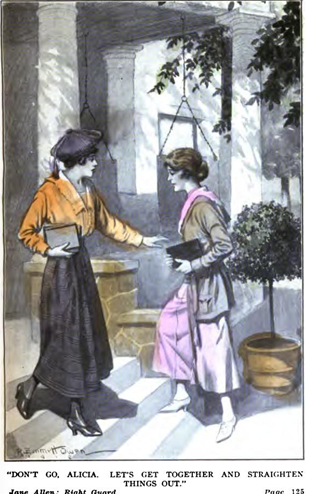
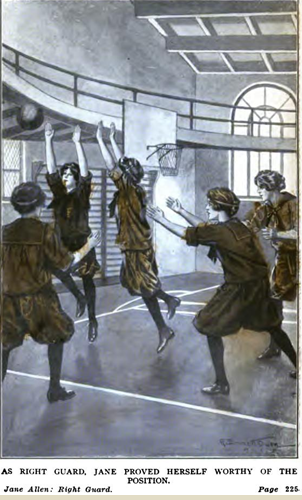
- The ebook is available here. Love the illustrations, even if one seems to be missing from this copy. They're by R. Emmett Owen. I haven't seen the first title's illustrations, but they're by Roy L. Williams
Tuesday, December 28, 2010
Jane Allen #1, Jane Allen of the Sub-Team
The Jane Allen College Series is, not surprisingly, about Jane Allen's life at Wellington College.
Jane Allen of the Sub-Team introduces Jane, who is 16 at this point, her father, Henry, who is a wealthy (natch) Montana rancher, and her spinster Aunt Mary, who has moved in with them after the death of Jane's mother ("Dearest," aka Dorothy) when Jane was 12. Is there any greater predictor of mortality than being the parent of a series heroine? Apparently it was Jane's mother's dying wish that she be educated at Wellington Seminary, which is now Wellington College. Jane is a spoiled tomboy who HATES the idea of going east to school. HATES.
Jane has never had girl friends her own age and can't see the point of courting them. She's rude and stand-offish, with a terrible temper. I enjoy having an imperfect heroine, but Jane at this stage is pretty much unbearable. Of course, with the encouragement of her roommate Judy Stearns and other friends, she eventually becomes more pleasant and makes friends. For a series whose gimmick is basketball, it's not introduced at all until the sixteenth chapter and isn't really a focus of the plot, which suits me just fine. Anyway, with some strategic injuries, illnesses, and resignations, Jane eventually makes the main team and leads them to victory over the sophomores.
- "Once she was imprisoned in that hateful seminary she would die. Her father and Aunt Mary would be sorry. She pictured herself slowly dying of grief and homesick longing. Some day, soon after they sent her away, a telegram would come to El Capitan. Her father would open it and read, 'Come at once. Your daughter died last night.' Then, when it was too late, they'd understand. Jane wept afresh in sheer sorrow for her untimely end." I wish the whole book were as funny as this passage implies.
- Jane has a portrait of "Dearest," to whom she talks. Dearest is her inspiration to do good.
- Jane reads a book series, Beatrice Horton's _____ Year at Exley (First through Fourth years), on her way east. For the record, it doesn't really exist, but I'm entertained by the whole meta aspect.
- She meets the series enemy, Marian Seaton on the train east. Her main flunky is Maizie Gilbert, and while she has others, they eventually defect. Seriously, over the course of the series, Jane inspires more conversions than a messianic figure.
- She lives at Madison Hall, under the auspices of Mrs. Weatherbee. Mrs. Weatherbee messes up the room assignment, and she and Jane haven't resolved their differences by the end of this book.
- Friends and character traits: Judy (bizarrely absent-minded), Dorothy Martin (benevolent/saintly upperclassmen), Adrienne Dupree (elfin daughter of French dancer), and Norma Bennet (poor girl working her way through Wellington waiting tables at Madison Hall).
- In old books like this, girls have "crushes" on each other, not on boys. They also invite each other to dances. I know Clair Blank hadn't been to college when she wrote the Beverly Gray books, but I wonder who had the boys at dances bit correct.
- They have a Morris chair in their room.
- The Rutherford Inn is their off-campus gathering place.
- Jane is tall, with auburn hair, grey eyes, and a size 5A foot. This is my own coloring, which I've always thought was relatively uncommon, but which fits at least one character in about every series.
- The series does have some fashion descriptions, but I'm not a huge fan of 1910s style, honestly.
How to Choose, or the Jane Allen College Series
Tuesday, December 21, 2010
The Thirteenth Spoon-Macrae Edition
Monday, December 20, 2010
The Jade Necklace-Macrae Edition
If I was pleased to have a different frontpieces, I was thrilled to find three internal illustrations, which the Cupples editions lack completely. As a note, the name that almost rivals Clytemnestra in the book is the "preposterous" Amanda.
I remembered that in the Cupples edition, Roslyn's name is misspelled Roselyn on the front dj flap. Apparently this is a carry over from the Macrae edition, because the same mistake is made.
This is a great book. If you'd like to read my original review, it's here.
Unexpected Christmas Surprises
Wednesday, November 10, 2010
Betsy Hale
The books have green and gold boards, and the dust jacket art is the same for all three volumes. I'm uncertain as to who did the dust jacket artwork, but Pem herself did the frontispiece and three internal illustrations for each book. The paper quality is quite good, and the stories range from 254-269 pages each. I will note that the frontispiece for my copy of Betsy Hale seems to be incorrect--it's one of the internal illustrations for Betsy Hale Succeeds.
At the beginning of Betsy Hale, Betsy is an imaginative and earnest 13 year old girl who has just moved with her widowed mother to Wee Corners, a small cottage that they've inherited in rural New England. Her mother is an author, in the vein of Jess's mother in the Girls of Central High series. In other words, they have no money, and Betsy is often left to assume household duties, financial worries, and generally fend for herself. Her primary friends are Emma Clara, Selma, and Philip, who is groomed, in my opinion, to be the future love interest of the series. The central conflicts in the book center around Mrs. Hale regaining her health, publishing a novel, and becoming financially stable.
In Betsy Hale Tries, the plot is based around trying to raise funds to establish a hospital in their small community, a venture spearheaded by Betsy and Philip. Along the way, Betsy makes a friend of Miss Willie, an eccentric older woman, and the family acquires Lucy as cook/housekeeper. Lots of themes of post WWI patriotism in this book, and there's a side plot involving a traveling circus.
I have no idea why the third book is titled Betsy Hale Succeeds. The plans of the last book have already succeeded, and this book is about how Betsy and her mother take in an alleged war orphan from France, Aimee. Of course, Aimee's parents are both alive in the end, her mother somehow ending up in some nearby town (from France. Really.), while her father had amnesia and a couple of amputations (final tally: one hand and one leg). The series ends with no references to phantom titles or future plans.
- I really didn't care for the character of Mrs. Hale. She's clueless about household chores and is one of those people in old stories that has to have complete rest and no worry or she'll have a breakdown. Wonder why the non-genteel poor never get those orders? Beyond that, she offers no emotional support to Betsy.
- Her mother has gotten them involved with a League of Truth and Simplicity after Betsy's father's death. So Elizabeth is now Betsy and has to wear brown sack dresses. I may be misreading, but I also think that Mommy Clueless loses a lot of money to them.
- Luckily, friends take pity on Betsy and gift her with a "lovely limp yellow frock" and a pink lawn dress.
- I really love Philip's character. His father is really sick in the first book (he eventually dies), and Betsy finds him crying hidden in the woods. She doesn't reveal herself, just has more sympathy and respect.
- Betsy can't get Philip to come visit another girl with her, because, "I don't play with girls." When she reminds him that they've gone off in the woods twice that week, he says, "You're different." Aw.
- Betsy is almost 15 at the end of the series. I think I would have enjoyed a continuation of the series, with more grown up themes. The target audience is probably about 12 for the books that were written.
I have mixed feelings about this series as a whole. I think it's well-written for a pre-teen age group, and Betsy is a likeable heroine. She has negative emotions and needs help to pull off schemes. She's not perfect. That said, I think I'd prefer an older heroine, stronger plotlines, and snappier/funnier dialogue. I'm building collections of the Hilda and Miss Pat series, which I'm hoping will be more to my liking. I've also tracked down the Macrae editions of The 13th Spoon and The Jade Necklace to share with you.